
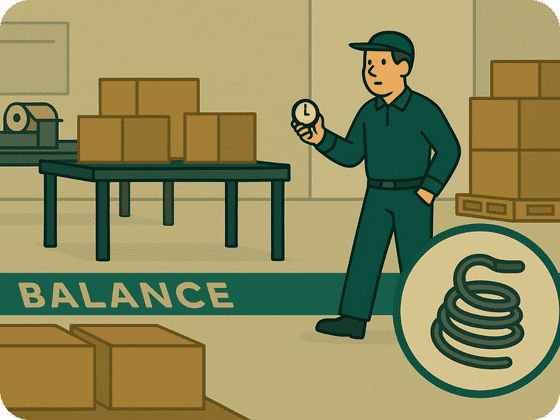
Manufacturing — Brake-Cable Line
Pain: Takt missed; long cycle times.
A3 balanced work-stations and removed material-handling waste (Pereira et al., 2019, Procedia Manufacturing).
Productivity +49 % | Cycle time −33 %
Read Case Study ↗
Born inside Toyota in the late-1960s, an A3 report started out as nothing more exotic than an A3-size sheet of paper (297 × 420 mm | 11 × 17 in). Engineers found the format large enough to fit charts, sketches, and handwritten notes—yet small enough to pin on an Obeya wall or carry to the gemba. Over time, that humble page evolved into a full-blown problem-solving discipline and, eventually, a leadership practice for developing people.
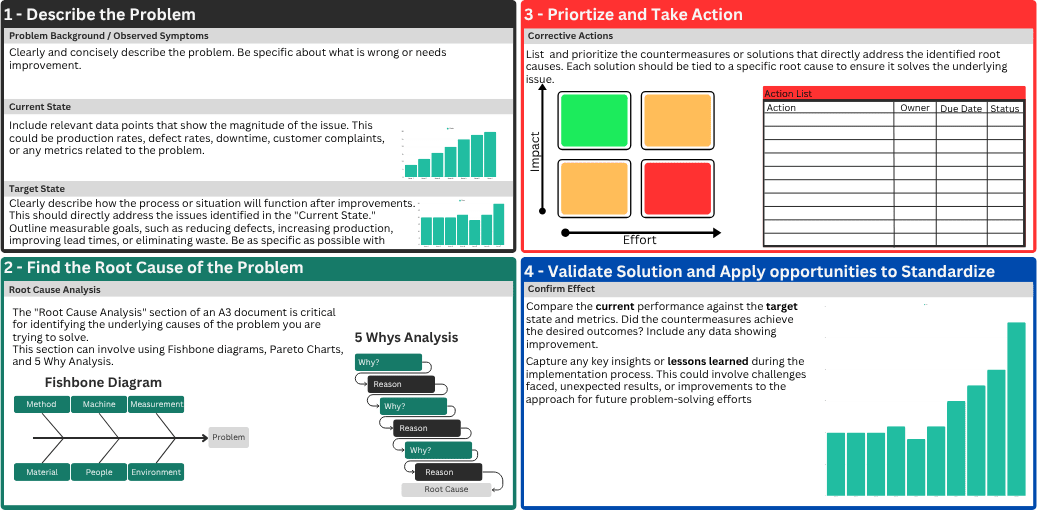
Today the term “A3” carries three intertwined meanings:
The Paper Size – A practical constraint that forces clarity. You must tell the entire story—problem, evidence, root causes, countermeasures, and follow-up—without spilling onto a second page.
The Thinking Process – A structured, PDCA-based flow that guides teams through five core sections: Problem & Background → Current Condition → Root-Cause Analysis → Countermeasures & Targets → Follow-Up. The template is simply a scaffold for that logic.
The Coaching Storyboard – A living visual that invites questions from mentors and peers. Leaders review drafts, probe for deeper “Why?” layers, and strengthen the author’s critical-thinking muscles. The sheet becomes a dialogue in ink.
Because all data, analysis, and actions live side-by-side, gaps in logic stand out instantly: if the root cause doesn’t link to a countermeasure, the page exposes it; if results aren’t checked, the blank Follow-Up box reminds the team to verify. In this way, an A3 report is both artifact and feedback loop—a single piece of paper that aligns stakeholders, accelerates learning, and captures organisational memory long after the ink dries.
Take your skills to the next level. Join 15,000+ practitioners and get exclusive tools delivered to your inbox.
No spam. Unsubscribe anytime.
A3 thinking isn’t just a template—it’s a miniature operating system for continuous improvement. Here’s why teams in manufacturing, healthcare, software, and even HR keep reaching for that single sheet:
Cuts Through Noise & Waste
Limiting the story to one page forces you to separate signal from clutter. Extraneous charts, pet theories, and “nice-to-haves” simply won’t fit. What remains are the facts that matter—making non-value-adding steps, delays, and hand-offs painfully obvious.
Builds a Coaching Culture
Because the sheet is public and iterative, leaders don’t “approve” it so much as coach it. They ask Socratic questions (“Where did you observe this?” “Which KPI will prove success?”*) that sharpen the author’s thinking. Over time, the organisation gains more problem-solvers, not just more reports.
Creates a Shared Visual Language
Engineers, operators, accountants, and executives can all stand around the same page and follow the flow left-to-right: problem → evidence → causes → actions → results. No lengthy slide decks, no hunting for the latest revision—just one living storyboard everyone can read in minutes.
Accelerates PDCA Loops
With the entire Plan-Do-Check-Act cycle visible at a glance, teams feel the urge to close the loop quickly. Follow-up boxes left blank are an eye-level reminder that learning isn’t finished until results are verified and standard work is updated.
Locks in Organisational Memory
Finished A3s become bite-sized case studies—pin them on an Obeya wall or save them in a digital gallery. When a similar issue crops up months later, the solution (and the thinking behind it) is already documented, sparing the team from reinventing the wheel.
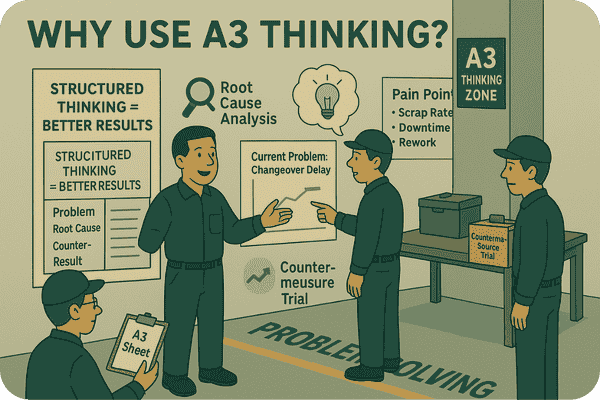
In short, A3 thinking replaces sprawling reports and siloed problem-solving with a concise, visual discipline that reduces waste, grows people, and spreads know-how across the enterprise.
Although different companies draw their A3 sheets in landscape or portrait—and may number the boxes 7, 8, or even 9—the logical backbone is always the same five-step PDCA flow. Think of it as a left-to-right storyboard: you first set the scene (Plan), then gather facts (Do), test your logic (Check), and finally lock in the gain (Act). Mastering these five boxes is 80 % of A3 success.
Purpose: Establish why this matters, now—in one or two sentences.
Start with the voice of the customer or KPI shift. “First-pass yield on Line B has slipped from 97 % to 92 % since 1 April 2025.”
Quantify the impact. Money lost, hours delayed, safety risk—pick the metric leadership already cares about.
Give essential context only. If new software went live last month, note it; if the scrap trend dates back three years, mention the baseline. Resist writing the company’s entire history.
Tip: Ask “Would a colleague from a different plant instantly grasp the pain?” If not, tighten the wording.

Purpose: Paint an evidence-based snapshot of reality. No guessing allowed.

Go to the gemba. Stand where the defect appears, follow material flow, watch the operator’s motion.
Show, don’t tell. Use a clear photo, time-series chart, or spaghetti diagram. One powerful visual beats four paragraphs.
Quantify variation. Note frequency, trend, or location of the problem. E.g., “80 % of defects occur on the night shift.”
Avoid causes here. Describing “why” too early contaminates the data with opinion.
Common formats: Pareto bar of defect codes, run chart of downtime, annotated workstation photo.

Purpose: Expose the real mechanism driving the gap—not just the first-order symptom.
Apply the 5 Whys. Start with the problem statement; ask “Why?” until you hit a controllable process factor.
Map contributory branches. Use a Fishbone/Ishikawa diagram (Man, Machine, Method, Material, Measurement, Environment) to avoid tunnel vision.
Verify each link with data or direct observation. Correlate torque-gun calibration records with the spike in loose fasteners; confirm procedure steps missed via time-study video.
Converge on a single root cause or a primary causal chain. Multiple weak theories dilute action and stall momentum.
Red flag: If your 5th Why answer is “operator makes mistake,” you have not reached root cause—keep going until you find a systemic factor you can change (fixture design, software logic, unclear work standard).

Take your skills to the next level. Join 15,000+ practitioners and get exclusive tools delivered to your inbox.
No spam. Unsubscribe anytime.
Purpose: Translate causes into concrete, testable actions and desired future metrics.
One countermeasure per root cause. Traceability keeps the narrative tight.
Define owner, deadline, and expected KPI shift. E.g., “Install torque-gun auto-shutoff; Maintenance; 15 Aug 2025; target FPY back to ≥ 97 %.”
Classify impact vs effort. Quick wins first; structural fixes next.
Pilot whenever sensible. A 2-day trial on one shift de-risks the full rollout.
Set numeric targets. “Reduce defect PPM by 50 %” is clearer than “improve quality.”
Mini-matrix: Countermeasure | Owner | Due | Cost | Predicted KPI.

Purpose: Close the PDCA loop, prove effectiveness, and hard-wire the learning.
Collect post-implementation data. Same KPI, same sampling method; compare before/after.
Visualise results on the A3. A second run chart with the new data or a green/red status icon keeps the story self-contained.
Decide:
Hit target? → Standardise: update work instructions, train operators, audit at 30- and 90-day marks.
Missed target? → Return to Step 3—your root-cause theory was incomplete.
Capture lessons learned. Why did this countermeasure work (or not)? Record so the next team can reuse or refine.
Share and archive. Pin the signed-off A3 to an Obeya wall or save in a digital gallery for future reference and onboarding.
Reminder: An unchecked Follow-Up box is a silent backlog item; schedule the review date at the start to keep momentum.

When you discipline yourself to walk through these five boxes in order—no skipping, no shortcuts—the A3 sheet stops being just a form and becomes a compact engine for learning. Problems shrink, teams grow, and each finished page adds another brick to your organisation’s knowledge wall.
Below is a step-by-step guide on how to do an A3, what tools you need and how long you should expect it to take.

Print blank A3 sheets or open a shared digital board; gather baseline KPIs and relevant photos.
Time: 30 min
Tools: A3 template, latest KPI charts

Observe the process where the issue occurs, capture photos/video, and interview frontline staff.
Time: 30 min
Tools: Camera, notebook

Co-write a one-sentence problem statement and paste key visuals into the Current-Condition box.
Time: 30 min
Tools: Whiteboard markers, printed photos

Facilitate 5 Whys and a Fishbone diagram; verify each causal link with data or observation.
Time: 60 min
Tools: Fishbone template, data print-outs

Link each root cause to a countermeasure; assign owner, due date, cost band, and expected KPI shift.
Time: 45 min
Tools: Impact-Effort matrix, dot-votes

Mentor probes logic, signs off the sheet, and sets a review date in the Follow-Up box before adjournment.
Time: 30 min
Tools: Calendar invite, A3 gallery
Pain: Takt missed; long cycle times.
A3 balanced work-stations and removed material-handling waste (Pereira et al., 2019, Procedia Manufacturing).
Productivity +49 % | Cycle time −33 %
Read Case Study ↗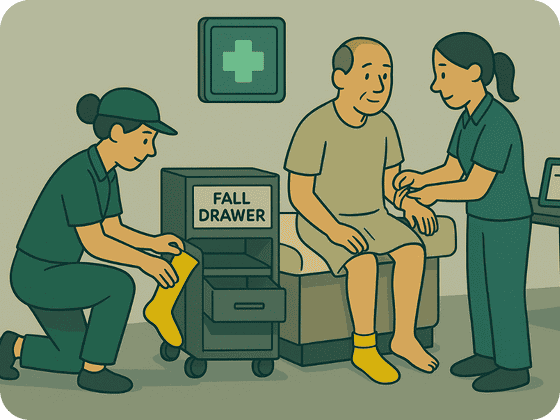
Pain: 9 patient falls / month (4 with injury).
A3 re-sequenced triage tasks & added visual “fall drawers” (Newsome et al., 2019, Moses Cone ED).
Falls −50 % | Falls-with-injury 0
Read Case Study ↗
Pain: Nightly batch ran 10 h; stale morning reports.
A3 removed duplicate script & set integration standards (Arthur, 2021, Lean Enterprise Academy).
Batch time −1 h / night | ≈ £8 k / yr server cost avoided
Read Case Study ↗To support you with your A3 problem solving, you can download our free A3 problem solving report from the template section of the website.
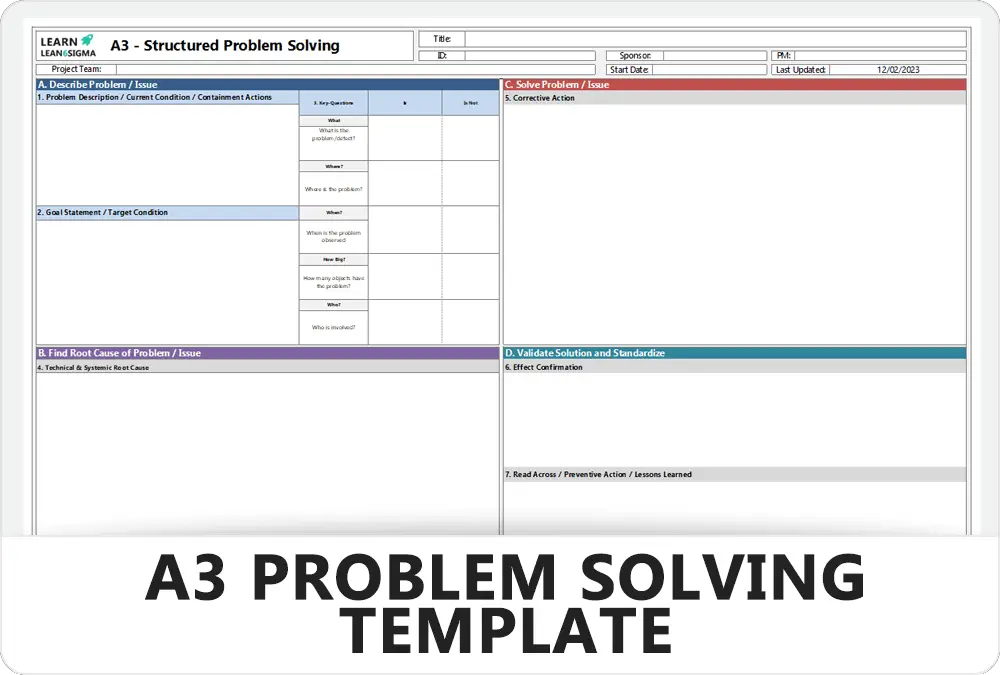
A3 problem-solving isn’t just a form—it’s a disciplined habit that fuses data, dialogue, and decisive action onto a single, shareable page. By walking the gemba, visualising root causes, and locking each counter-measure to a measurable target, you transform nebulous “issues” into clear experiments that build both capability and confidence across your team. The finished sheet becomes corporate memory you can pin on an Obeya wall, reference in audits, or use to onboard new colleagues—evidence that learning is happening every day.
If this guide has shown one thing, it’s that speed and rigour can coexist: you can draft an A3 in a morning and still meet ISO or customer requirements—no bloated slide decks required. Start small: pick a chronic nuisance, download the template, and run the six-step session. In a week you’ll have hard numbers, tighter teamwork, and the momentum to tackle the next challenge.
Continuous improvement begins with a single page—make yours count.
Arthur, B. (2021). Reducing nightly data-warehouse batch times with A3 problem-solving (A3 report). Lean Enterprise Academy. https://www.leanuk.org
Dennis, P. (2006). Getting the Right Things Done: A Leader’s Guide to Planning and Execution. Lean Enterprise Institute.
Liker, J. K. (2004). The Toyota Way: 14 Management Principles from the World’s Greatest Manufacturer. McGraw-Hill.
Newsome, R., Cunningham, J., & Kincaid, C. (2019). Decreasing Falls in the Emergency Department (Lean A3 poster). Moses Cone Health System. https://www.conehealth.com
Pereira, A., Silva, C., & Lopes, I. (2019). Application of the A3 methodology for the improvement of an assembly line. Procedia Manufacturing, 38, 447–454. https://doi.org/10.1016/j.promfg.2020.01.058
Rother, M., & Shook, J. (2003). Learning to See: Value-Stream Mapping to Add Value and Eliminate MUDA (2nd ed.). Lean Enterprise Institute.
Shook, J. (2009). Managing to Learn: Using the A3 Management Process to Solve Problems, Gain Agreement, Mentor and Lead. Lean Enterprise Institute.
Womack, J. P., Jones, D. T., & Roos, D. (1990). The Machine That Changed the World. Free Press.
All web links were last accessed on 6 July 2025.

Daniel Croft-Bednarski is a Continuous Improvement Manager with a passion for Lean Six Sigma and continuous improvement. With years of experience in developing operational excellence, Daniel specializes in simplifying complex concepts and engaging teams to drive impactful changes.