Prioritization Matrix Template

Systematically evaluate and rank potential solutions against weighted criteria. This tool removes subjectivity from decision-making, ensuring teams select the most effective option based on impact, cost, and feasibility.

★★★★★
4.6 653 reviews
18K + Downloads
Updated February 2026
Template Hero

About this Template

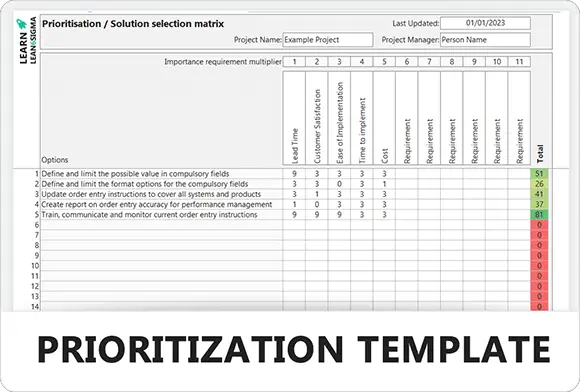
The Prioritisation Matrix (also known as a Solution Selection Matrix) is a decision-making tool used to objectively rank potential solutions. It filters multiple options against a set of weighted business criteria.

This tool is critical in the Improve Phase. When a team generates many ideas, they cannot implement all of them. This matrix uses data and consensus to identify which solutions offer the highest impact for the lowest cost/effort.

Use this template to remove emotion from decision-making, justify your project plan to stakeholders, and ensure you are working on the "Right" solution.

Pro Tip: Not all criteria are created equal. Apply an Importance Multiplier (Weighting) to critical factors like "Customer Satisfaction" so they influence the final score more than lesser factors.

OPTIONS CRITERIA A (Weight x9) CRITERIA B (Weight x3) CRITERIA C TOTAL SCOREOption 1: Automate 9 3 3 90 Option 2: Manual Check 1 3 9 27

Weighted Criteria

Allows teams to assign higher importance to critical business needs (e.g., Cost or Safety) over lesser factors.

Objective Scoring

Replaces gut feelings with hard numbers. Options are scored (e.g., 1, 3, 9) against the criteria to calculate a final rank.

Consensus Building

Acts as a collaboration tool. The discussion required to agree on scores aligns the team on the final decision.

Clear Selection

Provides a definitive "winner." The matrix highlights the solution that provides the most value relative to the constraints.

FREE

Join the 28-Day Lean Challenge

Take your skills to the next level. Join 15,000+ practitioners and get exclusive tools delivered to your inbox.

Daily Lessons 5 Bonus Templates PDF Guides
Start the Challenge

No spam. Unsubscribe anytime.

The 6-Step Selection Cycle

A systematic framework to filter ideas, apply objective criteria, and select the best solution. This process removes bias from decision making.

Step 01

List Potential Solutions

Gather all proposed ideas from your brainstorming sessions. Do not filter them yet—list every potential option in the first column of the matrix.

Goal:

A comprehensive list of at least 3-5 distinct options to compare.

Step 02

Determine Criteria

What does "success" look like? Define the specific business requirements each solution must meet. These become your column headers.

  • Impact: Customer Satisfaction, ROI.
  • Feasibility: Ease of Implementation, Time.
  • Cost: Budget requirements.
$ KEY FACTORS
Step 03

Assign Weights

Not all criteria are created equal. Assign an "Importance Multiplier" (e.g., 1 to 10) to each column. High-priority items like Safety or Quality often get higher weights.

Formula:

Score × Weight = Weighted Score.

x9 x3
Step 04

Score Options

Rate every solution against the criteria. Use a standard scale (e.g., 1, 3, 9) to force differentiation. Avoid using 1-5 scales if possible to prevent "clustering" in the middle.

  • 9: Strong positive impact.
  • 3: Moderate impact.
  • 1: Weak or no impact.
9 3 1 3 9 3
Step 05

Calculate & Rank

Multiply the rating by the importance weighting for each cell, then sum the rows. The solution with the highest total score is your statistical winner.

Output:

A ranked list based on data, not opinion.

Step 06

Select & Validate

Review the results. Does the winner make sense? If a high-cost solution won, re-check your weightings. Once validated, commit resources to the top choice.

  • Sanity Check: Does it feel right?
  • Commit: Allocate budget/team.
OPTION 1
Prioritisation FAQ

Common Questions

Why not just vote on the best idea?

Voting is subjective and prone to bias (e.g., the loudest voice wins). A Prioritisation Matrix uses objective data and weighted criteria. It ensures you select the solution that best meets business goals, not just the most popular one.
OPINIONS FACTS

What scoring scale should we use?

We recommend the 1-3-9 Scale (Low, Medium, High) rather than 1-5 or 1-10.

This non-linear scale forces differentiation. It prevents items from clustering in the middle (the "safe" 3 or 4) and clearly highlights the top performers.
1 3 9

How do I assign importance weights?

Weights reflect your project goals. If "Customer Satisfaction" is non-negotiable, give it a weight of 10. If "Ease of Setup" is nice-to-have, give it a 3.

Multiply the score by the weight to see the true impact on the final ranking.
10 3

What if the "best" score is too expensive?

This usually means "Cost" wasn't weighted heavily enough. However, the matrix is a guide, not a robot.

Review the top 3 options. You might choose the second-highest score if it fits the budget better, but the matrix forces you to acknowledge the trade-off in quality or speed.
Free for Personal Use

Free

Instant Download • No CC Required

Download Excel
Secure SSL 256-bit Encrypted

What's Included

Free Template

Prioritization Matrix Template

Download Now

On this page