Guide

Guide: Kaizen / Continuous Improvement

Updated Jun 24, 2026
2 Min Read
Discover how the five Kaizen principles—Teamwork, Personal Discipline, Morale, Quality-at-Source and Continuous Suggestions, turn daily micro-improvements into compounding gains that slash waste, lift engagement and accelerate customer value across any process.
Kaizen Continuous Improvement
Last Updated Jun 24, 2026
At a Glance
  • Small Steps, Big Impact: Focus on making small, incremental changes daily rather than waiting for massive, one-time overhauls.
  • Everyone is Involved: Kaizen is a culture where every employee, from the CEO to the shop floor, is empowered to suggest improvements.
  • Eliminate Waste (Muda): Relentlessly identify and remove non-value-added activities like waiting, overproduction, or defects.
  • The PDCA Cycle: Use Plan-Do-Check-Act as the standard engine for testing, validating, and implementing these improvements.
  • Standardization: Once an improvement works, update the standard process immediately so the gain is maintained and becomes the new baseline.

A team launches a continuous improvement programme. Posters go up, ideas are requested, a few workshops are run, and the first report-out feels positive.

Then a few months later, the same problems are still being discussed. Operators are still working around broken processes, supervisors are still firefighting, and the improvement board has quietly become a list of old actions.

The problem is usually not that people lack ideas. The problem is that the organisation has not built a daily system for turning problems into tested improvements.

That is where Kaizen matters. Kaizen is not simply an event, suggestion box or cost-saving campaign. It is the daily habit of making work better, one practical improvement at a time.

Kaizen flywheel

How daily improvement builds momentum

Kaizen works when problems are made visible, ideas are tested, standards are updated and learning is shared.

Daily
Kaizen
System

See the problem

The team identifies a real process issue through Gemba, visual management, KPI gaps or repeated frustrations.

Start with the real work, not assumptions.

What Is Kaizen?

Kaizen is a Lean approach to continuous improvement where people make small, regular improvements to processes, standards and ways of working.

The word is commonly translated as change for the better, but in practical Lean terms it means something more specific: improving the actual work, testing changes, learning from the result, and making the better method the new standard.

Kaizen is often misunderstood as a workshop or improvement event. A Kaizen event can be useful, but Kaizen itself is broader than that. It should be part of how teams manage work every day.

In a strong Kaizen system, problems are not hidden, ignored or passed upward without action. They are made visible at the Gemba, discussed by the people closest to the work, tested through small changes, and built into standard work when the improvement is proven.

Simple Definition

Kaizen is the practice of making small, practical, team-led improvements to the way work is done, then standardising what works so the process keeps getting better over time.

Good Kaizen is not about collecting as many ideas as possible. It is about creating a routine where useful improvements are identified, tested, implemented and sustained.

Meaning builder

Kaizen is more than having ideas

Click each part to see how a small idea becomes a real improvement.

+ + + =

Problem visible

Kaizen starts when the team can see a gap, waste, frustration or abnormal condition in the work.

No visible problem means no clear improvement target.

Kaizen vs Continuous Improvement

Continuous improvement is the broad idea of improving processes, products, services and systems over time. Kaizen is a practical Lean approach to continuous improvement, usually focused on small, frequent, team-led improvements.

The terms are often used together, and that is fine, but they are not always identical. Continuous improvement can include larger projects, Six Sigma work, automation, redesigns and strategic transformation. Kaizen usually refers to regular improvement activity carried out close to the work.

TermMeaningExample
Continuous ImprovementA broad approach to improving performance over time.An organisation-wide programme to improve quality, delivery and cost.
KaizenSmall, regular improvements made by people close to the work.An operator changes tool location to reduce walking and searching.
Kaizen EventA focused workshop to improve a specific process issue.A three-day changeover reduction workshop.
KaikakuA larger, more radical change or redesign.A new factory layout, major process redesign or new operating model.

Use the smallest improvement method that fits the problem. A small frustration may only need daily Kaizen. A repeated cross-functional issue may need a Kaizen event. A complex data-heavy problem may need A3 problem solving, root cause analysis or a DMAIC project.

Improvement scale

Choose the improvement method that fits the problem

Not every issue needs an event or project. Use the smallest method that can solve the problem properly.

Daily Kaizen

Best for small local frustrations, visible waste and simple improvements the team can test quickly.

Minutes to hours. Local team ownership.

The Core Principles of Kaizen

Kaizen is sometimes described through values such as teamwork, discipline and improvement culture. Those are useful, but they can become vague. For implementation, it is better to think in terms of practical operating principles.

A simple Kaizen system should follow five principles:

Start with the Real Work

Kaizen should begin by observing the actual process, not by guessing from a meeting room or spreadsheet.

Involve the People Closest to the Process

Operators, technicians, planners and supervisors often understand the real causes of waste better than people looking from a distance.

Test Small Changes

Kaizen favours simple, low-risk experiments rather than waiting for perfect solutions.

Standardise What Works

If the standard does not change, the improvement may not last. The new method needs to become the normal way of working.

Repeat and Share Learning

One improvement is useful. Repeated improvement across teams is where the culture starts to build.

Connect to Business Priorities

Kaizen should remove real waste, improve flow, reduce frustration and support safety, quality, delivery, cost or people goals.

The important point is that Kaizen should change the work. If people talk about improvement but the process, standard or behaviour does not change, the improvement has not really happened.

Principles

Five practical principles of Kaizen

These principles turn continuous improvement from a slogan into a daily operating routine.

Start with the real work

Kaizen should begin at the Gemba. Observe the actual process before deciding what needs to change.

Failure mode: improving based on assumptions from a meeting room.

Daily Kaizen vs Kaizen Events

Daily Kaizen and Kaizen events both have value, but they solve different types of problems.

Daily Kaizen is the habit of making small improvements regularly. These are usually local, practical and low risk. A Kaizen event is a more structured workshop where a team works intensively on a defined process problem.

The mistake is treating every improvement like an event. If the team can solve the issue in ten minutes, they do not need a three-day workshop. If the problem crosses departments or needs deeper observation, an event may be more appropriate.

AttributeDaily KaizenKaizen Event
PurposeSmall regular improvements.Focused improvement of a specific problem.
DurationMinutes to hours.Usually one to five days.
OwnershipLocal team.Cross-functional team.
Best forLocal frustrations, simple waste, quick fixes and standard work improvements.Changeovers, flow issues, layout problems, recurring losses and larger process gaps.
OutputImplemented improvement and updated standard.Implemented changes, action plan, owners, measures and follow-up.
Main riskIdeas are captured but not acted on.The workshop becomes a meeting with no real process change.
Method selector

Daily Kaizen, event, project or redesign?

Click a problem type to see the most suitable improvement approach.

Recommended approach

Use Daily Kaizen

This is a small local frustration that the team can usually test and improve without a formal workshop.

Example: moving a frequently used item closer to the point of work.

How a Daily Kaizen System Works

Daily Kaizen does not work because a company asks people to submit more ideas. It works when improvement becomes part of the team’s normal management routine.

A practical daily Kaizen system needs a simple flow. Problems should be visible, ideas should be easy to capture, owners should be clear, changes should be tested quickly, and successful improvements should be standardised.

The system should answer a few simple questions:

  • What problem or waste has been seen?
  • Who has suggested an improvement?
  • What change will be tested?
  • Who owns the action?
  • Did the change improve the process?
  • Has the new method been standardised?
Daily Kaizen board

A simple system for turning problems into improvements

Click each column to see how ideas should move from visible problem to standardised improvement.

Problems

Capture visible problems, waste, frustrations, missed standards and recurring abnormalities close to the work.

Avoid: only collecting vague suggestions without a clear process problem.

A useful Kaizen board is not a noticeboard. It should show the flow of improvement activity from problem to standardised result. If ideas sit on the board for months without decisions, the system will lose credibility quickly.

Pro Tip
Practical rule

A suggestion system without fast review and visible action becomes a complaint box. Keep the review cycle short and make decisions visible.

Examples of Kaizen in Practice

Kaizen does not need to be dramatic to be valuable. Many strong improvements are small changes that remove frustration, reduce waste or make the process easier to follow.

The examples below show the type of practical improvements that can come from daily Kaizen.

Tool Location Improvement

Problem: Operators repeatedly walk to collect shared tools.

Kaizen: Move frequently used tools to point-of-use storage or a shadow board.

Result: Less motion, less searching and a clearer standard for where tools belong.

Material Replenishment Trigger

Problem: Operators wait because materials run out before anyone reacts.

Kaizen: Create a simple two-bin Kanban or visual replenishment trigger.

Result: Fewer shortages and less waiting.

Quality Check at Source

Problem: Defects are discovered at final inspection.

Kaizen: Add a simple in-process check, visual standard or poka-yoke.

Result: Problems are caught earlier and rework is reduced.

Changeover Preparation

Problem: The machine is stopped while tools and materials are gathered.

Kaizen: Pre-stage changeover items before shutdown using SMED thinking.

Result: Less internal changeover time and better flow.

Examples

Examples of Kaizen in practice

Click an example to see the problem, waste type, Kaizen action and standard update.

Tool location improvement

Problem: operators walk repeatedly to find shared tools. Action: move frequent tools to a point-of-use shadow board. Standard update: define tool locations and missing-tool response.

Waste reduced: motion and waiting.

The common pattern is simple: identify waste, test a practical change, check the result, then update the standard so the better method is repeated.

How to Implement Kaizen Step-by-Step

Do not launch Kaizen as a slogan. Build it as a simple operating routine. Start with one area, make problems visible, help the team solve small problems, and create a rhythm for review and follow-up.

1

Choose One Area to Start

Start small. Pick one team, cell, department or process where problems are visible and leadership support exists. Do not try to launch everywhere at once.

2

Make Problems Visible

Use visual management, Gemba walks, waste walks, KPI gaps and team discussions to make real process problems visible.

3

Teach Simple Problem Solving

Give the team basic methods such as 5 Whys, PDCA, waste identification and standard work. Keep the method simple enough to use during normal work.

4

Create an Idea Capture Method

Use a physical board, digital form, team huddle sheet or simple Kaizen card. The method matters less than whether people actually use it and whether ideas are reviewed.

5

Review Ideas Regularly

Create a fixed rhythm. Review ideas daily or weekly depending on the area. Decide whether to do it now, test it, escalate it, reject it with explanation or convert it into a project.

6

Test Small Changes

Encourage low-cost, low-risk experiments. Not every idea needs a project charter. Many improvements can be trialled quickly if the risk is low.

7

Update the Standard

If the change works, update standard work, layouts, visual controls, checklists or training material. Without a standard update, the process can easily drift back.

8

Recognise and Share Improvements

Recognise implemented improvements, not just submitted ideas. Share useful changes with other teams through Yokoten so learning spreads beyond one area.

9

Track the System

Measure whether the system is active and useful. Track ideas implemented, cycle time to action, standards updated and the performance gaps reduced.

Implementation Warning

Do not make Kaizen another management-owned scheme. The aim is to help teams improve their own work, not to create a form that disappears into a system nobody checks.

How to Measure Kaizen Success

One of the easiest mistakes is measuring Kaizen by idea volume alone. A team submitting one hundred ideas with no implementation is not improving. It is only creating a backlog.

Measure both the health of the Kaizen system and the impact of the improvements.

Useful Leading Measures
  • Ideas implemented.
  • Ideas implemented per person.
  • Time from idea to decision.
  • Percentage of ideas acted on.
  • Number of standards updated.
  • Number of team-led improvements.
Useful Lagging Measures
  • Lead time reduction.
  • Defect reduction.
  • Waiting time reduction.
  • Changeover reduction.
  • Productivity improvement.
  • Safety, cost or OEE improvement.

The best measures depend on the purpose of your Kaizen system. In the early stages, cycle time to action and implemented ideas may matter more than financial savings. As the system matures, it should start to show improvement in operational performance.

Metrics

Measure implemented improvements, not just activity

Toggle between weak activity measures and more useful Kaizen system measures.

Ideas submitted

Useful to know, but volume alone does not prove improvement.

Workshops held

Activity measure. A workshop can happen without changing the process.

Posters created

Communication is not the same as an active improvement routine.

Warning: A team submitting 100 ideas with no implementation is not improving. It may simply be creating a larger backlog.

Ideas implemented

Shows whether the system converts ideas into action.

Cycle time to action

Shows how quickly ideas are reviewed, tested and closed.

Standards updated

Shows whether improvements are being sustained.

Gap reduced

Connects Kaizen to safety, quality, delivery, cost or morale performance.

Better test: Is the Kaizen system changing the work, reducing waste and improving the team’s ability to solve problems?

Common Kaizen Mistakes

Most Kaizen systems do not fail because people dislike improvement. They fail because the system becomes slow, unclear or disconnected from daily work.

Treating Kaizen as a Suggestion Box

Ideas without review, ownership or action damage trust. People stop contributing when nothing happens.

Waiting for Perfect Solutions

Kaizen should encourage small tests. If every idea needs a long approval route, the system will become too slow.

Managers Solving Everything

Managers should coach, remove barriers and support decisions. They should not take every problem away from the team.

No Standard Work Update

If the new method is not standardised, the process will drift back and the improvement will disappear.

Only Focusing on Cost Savings

Kaizen should also improve safety, quality, delivery, morale, flow and frustration in the work.

Ignoring the Gemba

Improvement based only on meeting-room assumptions often misses the real problem.

Running Events Without Daily Follow-Up

A workshop can create change, but daily management is usually what sustains it.

Measuring Ideas Instead of Improvements

Idea counts are not enough. The real question is whether useful changes were implemented and sustained.

Failure mode checker

Is your Kaizen system healthy?

Check the statements that are true. The result indicates whether you have a suggestion system or a working improvement routine.

0/8

Weak suggestion system

The routine is likely to create ideas but not enough implemented improvements. Focus on faster review, small tests and standard updates.

Frequently Asked Questions

What is Kaizen?

Kaizen is a Lean approach to continuous improvement where people make small, regular improvements to processes, standards and ways of working.

What does Kaizen mean?

Kaizen is commonly translated as change for the better. In Lean, it usually means improving work through regular, practical, team-led changes.

What is the difference between Kaizen and continuous improvement?

Continuous improvement is the broad idea of improving over time. Kaizen is a practical Lean approach that usually focuses on small, frequent improvements made by people close to the work.

What is an example of Kaizen?

A simple Kaizen example is moving frequently used tools closer to the point of work to reduce walking, searching and waiting.

Is Kaizen the same as a Kaizen event?

No. Daily Kaizen is ongoing improvement by the team. A Kaizen event is a focused workshop used to improve a specific process problem.

What are the main principles of Kaizen?

Practical Kaizen principles include starting with the real work, involving the people closest to the process, testing small changes, standardising what works and repeating the improvement cycle.

How do you start Kaizen?

Start with one area, make problems visible, teach basic problem solving, create a simple idea review routine, test small changes and standardise successful improvements.

How do you measure Kaizen?

Measure ideas implemented, improvement cycle time, standards updated, participation, performance gap reduction and business results such as lead time, defects, safety, cost and productivity.

Kaizen Starter Kit — Tools & Templates

A3 problem-solving sheet example 📄

A3 Problem-Solving Sheet

Frame the gap, goal and root causes on a single page during Step 1.

Open Template 🔗
5S audit checklist 🧹

5S Audit Checklist

Daily walk-through to expose clutter, motion and the seven wastes ↗.

Open Template 🔗
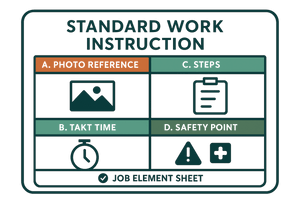
Standard work instruction template 🛠️

Standard-Work Instruction (SWI)

Lock in wins with photos, takt time and safety notes in Step 8.

Open Template 🔗
FREE

Join the 28-Day Lean Challenge

Take your skills to the next level. Join 15,000+ practitioners and get exclusive tools delivered to your inbox.

Daily Lessons 5 Bonus Templates PDF Guides
Start the Challenge

No spam. Unsubscribe anytime.

References

  1. Imai, M. (1986). Kaizen: The Key to Japan’s Competitive Success. McGraw-Hill.
    https://archive.org/details/kaizenkeytojapan0000imai

  2. Ohno, T. (1988). Toyota Production System: Beyond Large-Scale Production. Productivity Press.
    https://archive.org/details/toyotaproduction00ohnot

  3. Shingo, S. (1985). A Revolution in Manufacturing: The SMED System. Productivity Press.
    https://archive.org/details/revolutioninmanu00shin

  4. Perini, M., Ikonić, M., & Maričić, S. (2009). Die-casting process assessment using SMED. Metalurgija, 48(4), 249-252.
    PDF: https://hrcak.srce.hr/file/69416

  5. Mali, Y. R., & Inamdar, K. H. (2012). Change-over time reduction using SMED technique of lean manufacturing. International Journal of Engineering Research and Applications, 2(8), 1071-1078.
    PDF: https://www.ijrpr.com/uploads/V2ISSUE8/IJRPR1092.pdf

  6. Wiler, J. L., Welch, S., Pines, J., et al. (2010). Optimising emergency department front-end operations. Academic Emergency Medicine, 17(12), 1242-1247.*
    PDF: https://onlinelibrary.wiley.com/doi/pdf/10.1111/j.1553-2712.2009.00580.x

  7. Ravi. (2018). How can DevOps be implemented with Lean and Agile? Kanban University Pecha Kucha presentation.
    PDF: https://resources.kanban.university/wp-content/uploads/2018/06/Ravi_PechaKuchaFormat-How-can-DevOps-be-implemented-with-Lean-and-Agile-google-docs.pdf

  8. International Organization for Standardization. (2015). ISO 9001:2015 – Quality Management Systems – Requirements.
    Overview: https://www.iso.org/standard/62085.html

  9. Rother, M., & Shook, J. (2009). Learning to See: Value-Stream Mapping to Add Value and Eliminate Muda (2nd ed.). Lean Enterprise Institute.

  10. Shook, J., & Rother, M. (2009). Toyota Kata: Managing People for Improvement, Adaptiveness, and Superior Results. McGraw-Hill.

Daniel Croft-Bednarski

Continuous Improvement Manager
#1 Free Resource Library

Daniel Croft-Bednarski is a Continuous Improvement Manager with a passion for Lean Six Sigma and continuous improvement. With years of experience in developing operational excellence, Daniel specializes in simplifying complex concepts and engaging teams to drive impactful changes.

10+ Years Experience
50+ Projects Led
LSS Black Belt

The Complete
CI Library

DMAIC
Project Charter
SIPOC
Control Plan
Lean
5S Checklist
VSM
OEE Calc
Strat
SWOT
X-Matrix
Access All 50+ Templates