Standard Work Instructions Template

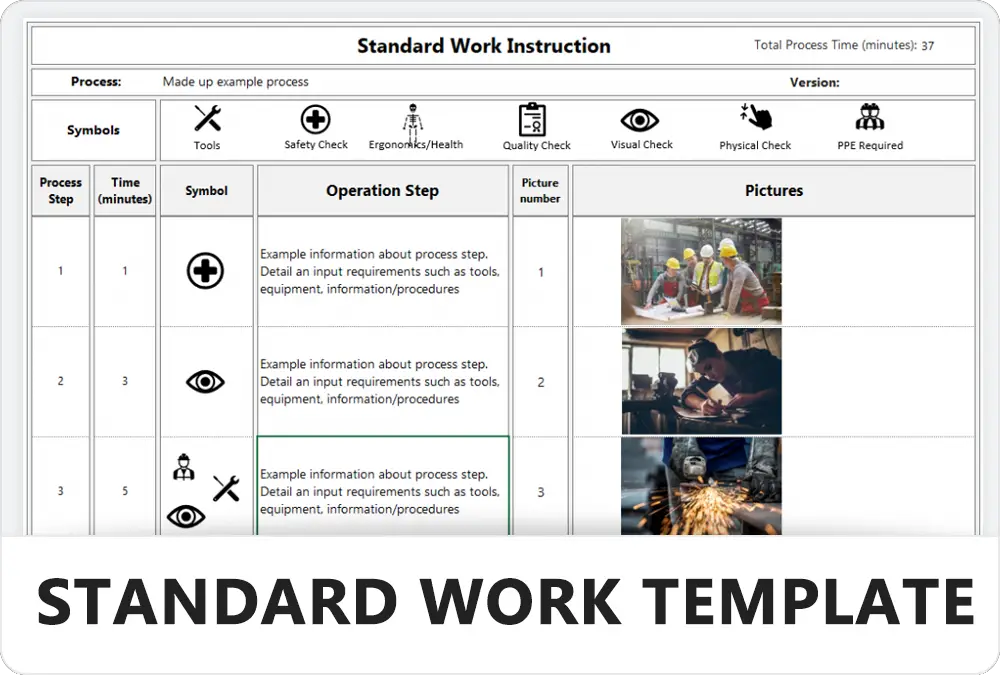
The Standard Work Instructions (SWI) Excel Template and Google Sheets a premade templates for streamlining and standardizing your business processes.

★★★★★
4.7 1289 reviews
83K + Downloads
Updated February 2026
Template Hero

About this Template

Standard Work Instructions (SWI) are the foundational documents of a Lean operating system. They document the current best practice for performing a task, ensuring that every operator performs the work the same way, every time.

Without standards, there can be no improvement. This template provides a structured layout to capture steps, key points, and safety requirements. It includes fields for Takt Time, Cycle Time, and visual diagrams to reduce ambiguity.

To suit your specific workflow needs, we have provided this template in three distinct formats: Microsoft Excel (for data-heavy tracking), Microsoft Word (for print-ready layout), and Google Sheets (for live collaboration).

Pro Tip: Standard Work is a "living document." It should not be locked away in a drawer. Print it out, post it at the workstation, and encourage operators to mark it up with red pens whenever they find a better, safer, or faster way to do the job.

STEP 1 STEP 2 RESULT

Eliminate Variation

Ensures that Shift A and Shift B perform the task exactly the same way, stabilizing quality output.

Multi-Format Support

Includes separate downloads for Excel (data), Word (print), and Google Sheets (cloud collaboration).

Rapid Onboarding

Serves as the primary training tool for new hires, reducing the learning curve and preventing bad habits.

Basis for Kaizen

You cannot improve a process that isn't stable. Standard work acts as the "wedge" that holds gains in place.

FREE

Join the 28-Day Lean Challenge

Take your skills to the next level. Join 15,000+ practitioners and get exclusive tools delivered to your inbox.

Daily Lessons 5 Bonus Templates PDF Guides
Start the Challenge

No spam. Unsubscribe anytime.

How to Implement Standard Work

Stabilize your process, eliminate variation, and create a baseline for continuous improvement. Follow this 4-step workflow.

Step 01

Observe the Current State

Go to the "Gemba" (where the work happens) and observe the process in real-time. Don't rely on what the manual *says* should happen; document what *actually* happens.

  • Watch: Observe multiple cycles and different operators.
  • Time: Measure cycle times to identify variation.
  • Note: Identify key safety points and quality checks.
Goal:

Identify the "Current Best Way" to perform the task safely and efficiently.

Step 02

Define the Best Practice

Break the work down into a clear, repeatable sequence.[Image of standard work breakdown structure] We recommend the TWI (Training Within Industry) structure to ensure depth and understanding.

  • Major Steps: What is the main action taking place?
  • Key Points: How is it done safely or to quality standards? (The "Knack")
  • Reasons: Why must it be done this way? (Crucial for buy-in)
The Golden Rule:

If the worker hasn't learned, the instructor hasn't taught.

STEP KEY POINT REASON
Step 03

Visualize the Standard

A picture is worth a thousand words. Replace dense paragraphs with clear photos or diagrams. This reduces language barriers and makes the standard instantly understandable.

  • Photos: Show the "Correct" vs. "Incorrect" way.
  • Diagrams: Use arrows to show motion or direction.
  • Symbols: Use safety icons (PPE, Warning) for critical steps.
Step 04

Train & Display

The standard only works if it's used. Train your operators on the new standard and post the document visually at the workstation.

  • Verification: Watch the operator perform the task to confirm understanding.
  • Visibility: Place it at eye level where the work is done.
  • Kaizen: Encourage the team to "red line" the document when they find improvements.
Result:

Consistent quality, predictable output, and a stable foundation for improvement.

POSTED AT GEMBA
FAQ

Common Questions

Does Standard Work kill creativity?

No, quite the opposite. By standardizing the routine tasks, you free up mental capacity for problem-solving. Furthermore, Standard Work is the baseline for improvement (Kaizen). Without a standard, you cannot tell if a change is actually an improvement or just variation.

What is the difference between an SOP and Standard Work?

An SOP (Standard Operating Procedure) typically tells you what to do (often for compliance). Standard Work tells you how to do it most efficiently, including specific details like timing (Takt Time), sequence, and standard WIP (Work in Process). Standard Work is usually more visual and user-centric.

Who should write the Standard Work instructions?

Ideally, the people doing the work should be heavily involved. While a process engineer or supervisor might draft the document, the operators perform the task daily and know the nuances. Involving them ensures accuracy and increases buy-in for following the standard.

How often should Standard Work be updated?

It is a "living document." It should be updated immediately whenever a process improvement is found and verified. If a Standard Work document hasn't been changed in a year, it's likely the process has drifted or improvement has stalled.

Why do you recommend using photos?

Text is ambiguous; photos are concrete. A photo showing exactly how to hold a tool or orient a part eliminates language barriers and reduces interpretation errors. Visual standards are learned faster and followed more consistently than text-heavy documents.
Free for Personal Use

Free

Instant Download • No CC Required

Download Excel Download Word Doc Open in Google Sheets
Secure SSL 256-bit Encrypted

What's Included

Free Template

Standard Work Instructions Template

Download Now

On this page