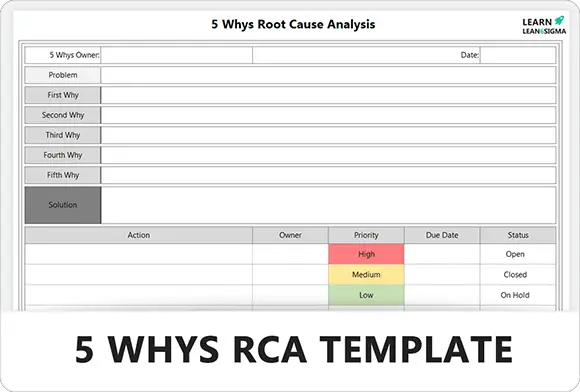
5 Whys Template

Use this 5 Whys Excel template to drill into root causes, document each why-answer chain, validate causes, and prevent superficial fixes from recurring problems effectively.

★★★★★
4.2 856 reviews
33K + Downloads
Updated February 2026
Template Hero
Autosave Off 5 Whys Analysis Template.xlsx
_
File
Home
Insert
Draw
Page Layout
Formulas
Data
📋 Paste B I U 田 Borders 🎨 Fill Merge & Center
B2
fx
5 Whys Root Cause Analysis
ABCDE
1
25 Whys Root Cause Analysis
3
4Project Name:Q2 Defect ReductionDate:Oct 12, 2024
5Team Lead:Jane DoeDepartment:Production
6
7StepDescription / QuestionStatusOwner
8Problem StatementThe conveyor belt motor overheated.OpenJ. Doe
9Why 1?Because the cooling fan failed.VerifiedM. Smith
10Why 2?Because debris clogged the intake.VerifiedM. Smith
11Why 3?Because the filter was missing.VerifiedK. Lee
12Why 4?It was removed for cleaning and not replaced.PendingK. Lee
13Why 5?No checklist step to confirm replacement.PendingJ. Doe
14
15Root CauseLack of standard work instruction for filter maintenance.
16CountermeasureUpdate maintenance SOP to include "Verify Filter Replaced" checkbox.ToDoTeam
5 Whys Template
+
Ready Display Settings 100% - +

About this Template

The 5 Whys is one of the most effective tools in the Lean Six Sigma toolkit for stopping the "firefighting" cycle. Originating from the Toyota Production System, it operates on a basic premise: surface-level problems are often just symptoms of deeper systemic issues. By asking "Why?" five times, you can peel back the layers to reveal the underlying root cause.

This template offers a structured layout to document the problem description, record the iterative "Why" questions, and most importantly, assign a corrective action to the final root cause. It is designed specifically for problems with linear causality (where A leads directly to B, which leads to C).

Pro Tip: If you find yourself blaming a human ("The operator forgot"), you haven't gone deep enough. A "human error" is usually a symptom of a process failure. Ask "Why did the process allow them to forget?" to find the true fix (e.g., lack of visual controls or confusing labels).

Drill Down Logic

Prevents "jumping to conclusions." The layout forces the team to validate the logical link between each cause and effect before moving to the next level.

Beyond Symptoms

Helps teams distinguish between "Direct Causes" (the fuse blew) and "Root Causes" (the maintenance schedule was undefined), ensuring you fix the problem permanently.

Action Oriented

Finding the cause is only half the battle. This template includes dedicated fields for defining the Countermeasure, assigning an Owner, and setting a Deadline.

Standardized Record

Creates a clear audit trail of decision-making. This prevents tribal knowledge loss and keeps the same problems from resurfacing six months later.

FREE

Join the 28-Day Lean Challenge

Take your skills to the next level. Join 15,000+ practitioners and get exclusive tools delivered to your inbox.

Daily Lessons 5 Bonus Templates PDF Guides
Start the Challenge

No spam. Unsubscribe anytime.

The 5 Whys Analysis Template

A simple yet powerful iterative interrogative technique used to explore the cause-and-effect relationships underlying a particular problem to determine root causes.

Step 01

Define the Problem Statement

Start with a clear, factual statement of the immediate problem you are observing. Focus on the symptom, not what you *think* the cause is.

  • Observations Only: Write down what is actually happening versus what should be happening.
  • Be Specific: Avoid generalizations like "It's broken." Use data if possible.
  • Keep it Brief: A single sentence is usually best.
Good Example:

"The CNC machine stopped mid-cycle at 10:30 AM today, displaying error code E401."

! SYSTEM HALT: E401
Step 02

Ask "Why?" repeatedly

This is the core of the method. Ask why the problem happened. Then, take that answer and ask why *that* happened. Repeat this 3-5 times to peel back the layers.

  • Avoid Blame: Focus on processes, not people. "Why did the process fail him?" not "Why did he fail?"
  • Verify Answers: Ensure your answers are based on facts, not assumptions.
  • Go Deep: Don't stop at the first easy answer.
Tip:

You don't have to stop at exactly five. Stop when asking "why" no longer yields a useful, actionable answer.

1. Symptom (Problem) Why? 2. Direct Cause Why? 3. Contributing Cause Why? 4. Deeper Cause...
Step 03

Identify the Root Cause

You have reached the root cause when asking "why" yields a systemic issue, a flawed process, or a missing policy that you have the power to change.

  • Actionable: A good root cause points directly to a solution.
  • Systemic: It usually involves a lack of standard work, training, or preventative maintenance.
  • The "Aha!" Moment: It explains all the symptoms above it in the chain.
Stop when you reach something like:

"There is no preventative maintenance schedule defined for this motor."

ROOT CAUSE (Systemic Issue)
Step 04

Define & Implement Countermeasure

Don't just put a bandage on the symptom. Implement a corrective action that directly addresses the root cause to prevent recurrence.

  • Specific Action: "Update SOP v1.2 to include monthly motor lubrication" (not just "train operators").
  • Assign Owner: Who is responsible for this action?
  • Set Due Date: When will it be completed?
  • Monitor Effectiveness: Did the problem come back?
Goal:

The goal isn't just to fix it for today, but to ensure this specific chain of events cannot happen again.

ROOT CAUSE Action Plan Defined FIXED & VERIFIED
FAQ

Common Questions

Do I have to stop at exactly 5 Whys?

No. The number 5 is a rule of thumb. You might reach a root cause in 3 whys, or it might take 7. You should stop asking "why" when you reach a Systemic Cause (a broken process, policy, or lack of training) that you have the authority to fix.

What is the biggest mistake people make?

Stopping at "Human Error." Blaming an individual is a symptom, not a root cause. If an operator made a mistake, you must ask: "Why did the system allow them to make that mistake?" or "Why were they not trained to avoid it?"

How do I verify my logic is sound?

Use the "Therefore" Test. Once you have written your 5 Whys down, read them backwards from the root cause up to the problem using the word "therefore." If the sentence doesn't make logical sense in reverse, you may have skipped a step or made a logic leap.

When should I use Fishbone vs. 5 Whys?

They work best together. Use a Fishbone Diagram first to brainstorm all potential factors (Breadth). Then, take the most likely factors from the Fishbone and apply the 5 Whys to drill down into them (Depth).

Can I have multiple root causes?

Yes. While the standard 5 Whys is a linear path, complex problems often branch. You can create a "5 Whys Tree" where one answer splits into two paths. Just ensure you follow both paths down to their respective root causes.
Free for Personal Use

Free

Instant Download • No CC Required

Download Excel
Secure SSL 256-bit Encrypted

What's Included

Free Template

5 Whys Template

Download Now

On this page