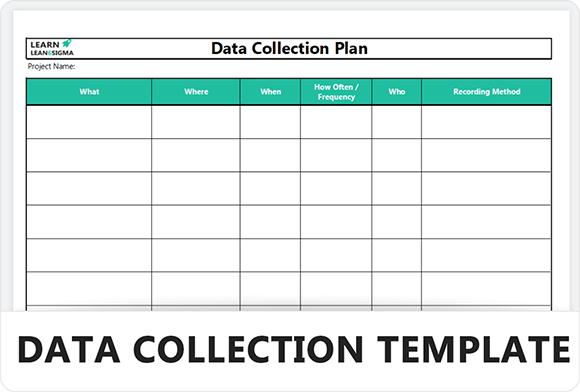
Data Collection Plan Template

Establish clear operational definitions, measurement methods, and sampling strategies. This template ensures the data you gather is accurate, consistent, and ready for valid statistical analysis.

★★★★★
3.7 346 reviews
8K + Downloads
Updated February 2026
Template Hero

About this Template

The Data Collection Plan is the blueprint for gathering reliable information. It prevents the common pitfall of "Garbage In, Garbage Out" by defining exactly what to measure, how to measure it, and how much data is needed.

Typically created in the Measure Phase of Lean Six Sigma, this document ensures that everyone on the team collects data in the exact same way, eliminating variation caused by the measurement process itself.

Use this template to establish clear operational definitions, select the right data types, and determine your sampling strategy before you start collecting.

Pro Tip: Before full-scale collection, perform a "Pilot Run" with a small sample size. This validates your collection form and ensures your Operational Definitions are clear to all operators.

Q QUESTION M METRIC OP DEF The "How-To" T DATA TYPE S SAMPLING

Operational Definitions

Removes ambiguity by defining exactly what is being measured and how, ensuring different people get the same result.

Data Type Selection

Distinguishes between Continuous (richer data, smaller sample sizes) and Discrete (attribute data, larger sample sizes).

Stratification

Identifies the "tags" (Shift, Machine, Operator, Location) needed to slice the data later for root cause analysis.

Sampling Strategy

Defines how much data to collect (Sample Size) and how often (Frequency) to ensure the data represents reality.

The 4 Pillars of Data Collection

Bad data leads to bad decisions. A robust Data Collection Plan defines exactly what, how, and how much to measure before you start.

VAGUE Late? Error? PRECISE

1. Operational Definitions

Remove ambiguity. "Late" is not enough. Define it: "Any request received after 5:00 PM local time." If two people can measure it differently, the definition failed.

The "What"
DISCRETE 5 CONTINUOUS 24.5mm

2. Data Type

Decide the format. Discrete (Pass/Fail, Count) is easier to collect but holds less info. Continuous (Time, Weight, Length) is richer and requires smaller sample sizes.

The "Format"
n=5

3. Sampling Strategy

Measuring 100% of the population is often too expensive. Define a sampling plan (e.g., "Random," "Systematic every 5th unit," or "Stratified") to get representative data.

The "How Much"
SHIFT 1 SHIFT 2

4. Stratification Factors

Plan for analysis before you collect. Add "tags" to your data form (Who, When, Machine ID, Location) so you can slice and dice the data later to find patterns.

The "Labels"

Data Collection Strategy

Reliable analysis starts with reliable data. This framework ensures that what you measure reflects reality. We move from vague concepts to precise operational definitions and structured sampling.

PROCESS REALITY Unobserved Events True Temperature Physical Defect Cycle Time MEASUREMENT Op. Definitions Trusted Data Ready for AnalysisTHE RECORD Dataset / Log Sheet
DEFINITION

Operational Definitions

This removes ambiguity. We translate vague concepts (e.g., "Late Delivery") into specific, measurable rules (e.g., "Received >15 mins after scheduled time"). This ensures consistency across all operators.

STRATEGY

Sampling & Stratification

We define Sampling (how much data is enough to represent the whole?) and Stratification (what "tags" like Shift, Machine, or Date do we need to attach to slice the data later?).

FREE

Join the 28-Day Lean Challenge

Take your skills to the next level. Join 15,000+ practitioners and get exclusive tools delivered to your inbox.

Daily Lessons 5 Bonus Templates PDF Guides
Start the Challenge

No spam. Unsubscribe anytime.

Data Collection FAQ

Common Questions

Why can't we just start measuring immediately?

Without a plan, you risk the "Garbage In, Garbage Out" scenario. A Data Collection Plan acts as a filter, ensuring you define what to measure and how to measure it, so the analysis downstream is actually valid.
PLAN

Which is better: Continuous or Discrete data?

Continuous data (time, weight, length) is far superior. It tells you the magnitude of the problem.

Discrete data (pass/fail, good/bad) is like a staircase—you lose detail. Always try to measure on a continuous scale if possible (e.g., measure "15.2 minutes late" instead of just "Late").
DISCRETE CONTINUOUS

How do I determine the Sample Size (n)?

Sample size depends on your desired precision and the underlying variation in the process.

If the process is very noisy (high variation), you need a larger sample (n) to see the true signal. If you need to be 99% confident in your result, you also need a larger n.
n

What is a "Pilot Run" and why do I need it?

A Pilot Run is a small-scale test of your data collection form and method. It reveals confusion immediately (e.g., "Wait, did you mean 5 PM EST or CST?"). Fixing these issues before collecting thousands of data points saves massive amounts of time.
TEST FIRST FULL SCALE
Free for Personal Use

Free

Instant Download • No CC Required

Download Excel
Secure SSL 256-bit Encrypted

What's Included

Free Template

Data Collection Plan Template

Download Now

On this page