PICK Chart Template

Streamline project management with our free PICK Chart Template, designed to categorize and prioritize ideas effectively for better decision-making outcomes. Available in Excel and Google Sheets.

★★★★★
4.0 674 reviews
10K + Downloads
Updated February 2026
Template Hero

About this Template

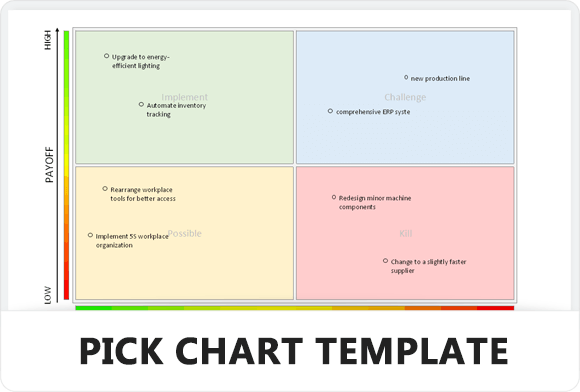
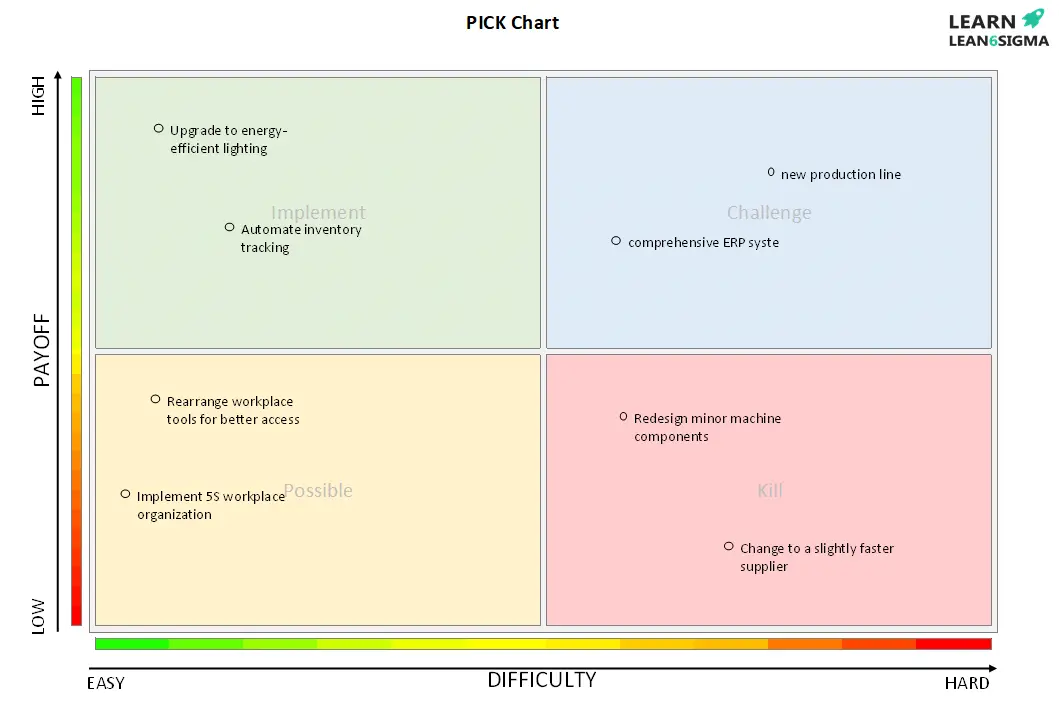
The PICK Chart is a visual prioritization tool used to organize ideas, issues, or projects based on two dimensions: Impact (Payoff) and Difficulty (Effort). It is commonly used after a brainstorming session to decide what to work on first.

The acronym stands for the four quadrants of the matrix:
Possible (Low Effort, Low Payoff), Implement (Low Effort, High Payoff), Challenge (High Effort, High Payoff), and Kill (High Effort, Low Payoff).

Use this template to rapidly filter a backlog of ideas and reach consensus on your "Quick Wins" versus your "Major Projects."

Pro Tip: Do not overload the "Implement" quadrant. If everything is a priority, nothing is. Be honest about the Effort required—if it requires IT approval or capital expenditure, it's likely a "Challenge," not an "Implement."

EFFORT / DIFFICULTY IMPACT / PAYOFF IMPLEMENT IMPLEMENT CHALLENGE CHALLENGE POSSIBLE POSSIBLE KILL KILL Idea 1 Idea 2 Idea 3 Idea 4

Implement (Just Do It)

High Payoff, Low Effort. These are your gold nuggets. Execute these ideas immediately to build momentum.

Challenge (Projects)

High Payoff, High Effort. These require planning and resources. They often become formal Six Sigma or DMAIC projects.

Possible (Fill-ins)

Low Payoff, Low Effort. Do these only when you have spare time. They are "nice to have" but don't drive significant value.

Kill (Discard)

Low Payoff, High Effort. These ideas drain resources for little return. Reject them or redefine the scope.

FREE

Join the 28-Day Lean Challenge

Take your skills to the next level. Join 15,000+ practitioners and get exclusive tools delivered to your inbox.

Daily Lessons 5 Bonus Templates PDF Guides
Start the Challenge

No spam. Unsubscribe anytime.

The Prioritization Cycle

A structured approach to turn a chaotic list of ideas into a clear action plan. Filter out the noise and focus on high-impact activities.

Step 01

Brainstorm Ideas

Gather the team and generate as many solutions as possible. Don't filter or judge them yet—just get them on sticky notes (virtual or physical).

Goal:

Quantity over quality. Capture every potential option.

Step 02

Define Parameters

Agree on what "High Impact" and "High Effort" actually mean for this project. Without clear definitions, placement becomes subjective arguing.

  • Impact: ROI, Customer Satisfaction, Safety.
  • Effort: Cost, Time, Resource availability.
LOW HIGH
Step 03

Plot the Ideas

Take one idea at a time. Ask the team: "Is this high or low effort? Is it high or low impact?" Place the sticky note into the corresponding quadrant (P, I, C, or K).

Tip:

Don't overthink precise placement. Quadrant is what matters.

Step 04

Select Winners

Focus immediately on the Implement quadrant (High Impact, Low Effort). These are your "Just Do It" tasks. Next, plan the Challenge quadrant projects.

  • Implement: Do now.
  • Challenge: Plan for later.
Step 05

Kill the Rest

Be ruthless with the Kill quadrant (Low Impact, High Effort). Stop discussing them. Archive them or throw them away to free up mental space.

Action:

Remove from backlog.

Step 06

Assign & Execute

A priority list is useless without ownership. Assign a specific owner and a due date to every selected item in the Implement and Challenge quadrants.

  • Assign: Who is doing it?
  • Track: When is it due?
Facilitation FAQ

Common Questions

What exactly do the quadrants mean?

Implement (I): High Impact, Low Effort. Do these first (Quick Wins).
Challenge (C): High Impact, High Effort. Plan these as major projects.
Possible (P): Low Impact, Low Effort. Do these only if you have spare time.
Kill (K): Low Impact, High Effort. Eliminate these ideas immediately.
I C P K Impact (Y) vs Effort (X)

What if an idea falls on the line?

Don't let it sit on the fence. Force a decision.

If you are unsure about the Impact, be conservative and move it down. If you are unsure about the Effort, assume it will be harder than you think and move it right.
Force the choice

Why should we "Kill" ideas?

Resources are finite. "Kill" doesn't mean the idea is bad; it means the return on investment (ROI) isn't high enough right now compared to the effort required.

Removing these distractions allows the team to focus 100% of their energy on the high-value "Implement" and "Challenge" items.
Focus > Volume

How do we define "High Effort"?

Effort is subjective, so agree on a standard before you start. Common "High Effort" triggers include:

1. Requires IT development or coding.
2. Capital expenditure (CAPEX) approval needed.
3. Takes longer than 3 months to implement.
4. Requires cross-departmental coordination.
$ Hr
Free for Personal Use

Free

Instant Download • No CC Required

Download Excel Open in Google Sheets
Secure SSL 256-bit Encrypted

What's Included

Free Template

PICK Chart Template

Download Now

On this page