Is/Is Not Template

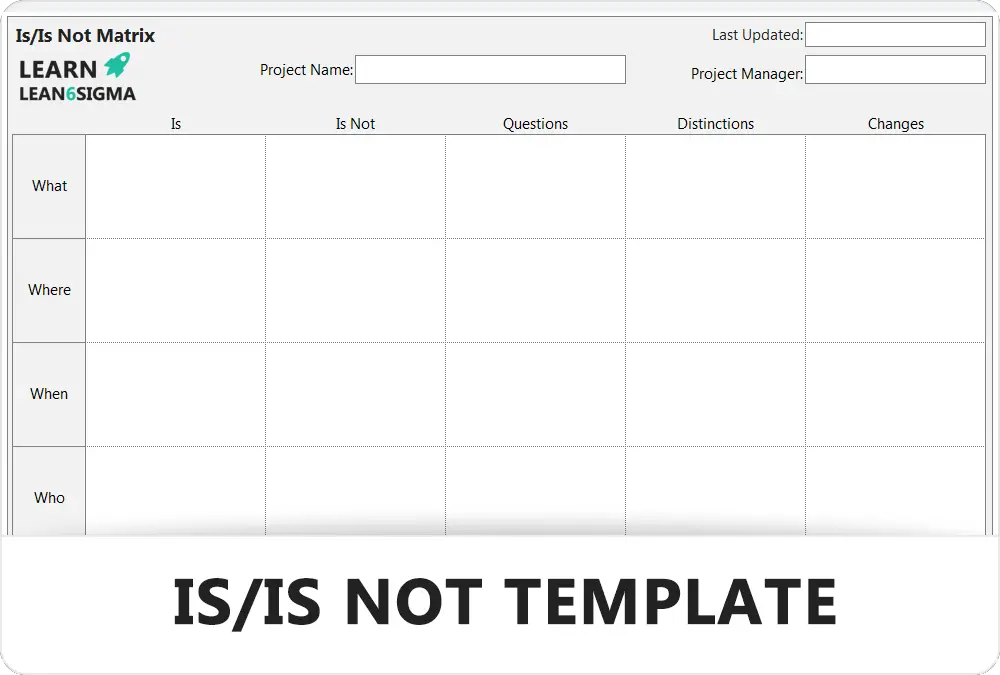
The Is/Is Not 5W1H Template defines problem boundaries by comparing what the issue is versus what it is not. Use it to prevent scope creep and sharpen your root cause analysis.

★★★★★
4 254 reviews
4K + Downloads
Updated February 2026
Template Hero

About this Template

The Is/Is Not 5W1H Analysis is a critical problem definition tool used in the Define phase of Six Sigma and 8D methodologies. It sharpens the scope of an investigation by explicitly stating what the problem IS (the facts) and contrasting it with what the problem IS NOT (but could reasonably be).

By systematically answering Who, What, Where, When, Why, and How (5W1H), this template helps teams eliminate irrelevant theories, prevent scope creep, and identify the "Distinction"—the unique variable that causes the defect.

Use this template before starting Root Cause Analysis (Fishbone/5 Whys) to ensure you are solving the specific problem, not a vague symptom.

Pro Tip: The most valuable column is the Distinction. If the problem IS on Line A, but IS NOT on Line B, the distinction (e.g., "Line A was serviced yesterday") often points directly to the root cause.

IS (The Problem) IS NOT (The Scope)WHAT Cracked Gear Bent Gear WHERE Line 1 Line 2 & 3 WHEN Morning Shift Night Shift

Defined Boundaries

Clearly establishes what is in scope and what is out of scope, preventing the team from trying to "boil the ocean."

Fact-Based Comparison

Replaces assumptions with data. You must prove something IS NOT part of the problem before excluding it.

Find the Distinction

Highlights the differences. If Line 1 fails but Line 2 doesn't, the Distinction between them is the likely cause.

5W1H Structure

Ensures completeness by forcing the team to answer Who, What, Where, When, Why, and How.

FREE

Join the 28-Day Lean Challenge

Take your skills to the next level. Join 15,000+ practitioners and get exclusive tools delivered to your inbox.

Daily Lessons 5 Bonus Templates PDF Guides
Start the Challenge

No spam. Unsubscribe anytime.

The Definition Cycle

A systematic process to define the problem scope by identifying exactly what it IS and what it IS NOT. This prevents wasted effort on irrelevant areas.

Step 01

What (Object & Defect)

Describe the specific object having the problem and the specific defect. Then, describe similar objects or defects that are NOT happening.

Example:

IS: Cracked Screen. IS NOT: Scratched Case.

Step 02

Where (Geographic & On Object)

Identify the physical location (e.g., Plant A) and the location on the object (e.g., Top Left Corner). Contrast this with where the defect is NOT seen.

  • IS: Line 1.
  • IS NOT: Line 2 or 3.
A B
Step 03

When (Time & Pattern)

When was the defect first seen? When does it occur in the cycle? Is it continuous or random? Contrast with times when the process runs smoothly.

Tip:

Look for start-ups, shift changes, or specific days.

12
Step 04

Who (Operators & Customers)

Who is involved when the problem happens? Is it specific to one operator, one shift, or one supplier? Who is NOT experiencing the problem?

  • IS: New Trainees.
  • IS NOT: Experienced Staff.
Step 05

How Much (Extent)

Quantify the problem. How many units are affected? What is the trend (increasing, decreasing, stable)? Contrast with the quantity of good parts.

Data:

e.g., 5% of production, or 3 units per hour.

Step 06

Find the Distinction

This is the key step. Review the differences between IS and IS NOT. What is unique about the "IS" side? This distinction often points directly to the root cause.

  • Ask: What changed?
  • Result: A narrowed scope for RCA.
Analysis FAQ

Common Questions

Why do we need the "IS NOT" column?

Defining what the problem IS NOT helps eliminate incorrect theories early.

If the defect happens on Line A (IS) but never on Line B (IS NOT), you stop wasting time investigating materials shared by both lines. You focus 100% on what makes Line A unique.
A B

What is the "Distinction"?

The Distinction is the specific change or difference between the IS and the IS NOT.

Example:
IS: Morning Shift.
IS NOT: Afternoon Shift.
Distinction: Morning shift is colder because the heating hasn't warmed up yet.
This distinction points directly to temperature as a potential root cause.
!

When should I use this tool?

Use it at the very beginning of the Define Phase (DMAIC) or D2 (8D).

Do not start Fishbone or 5 Whys until you have completed the Is/Is Not. If you try to solve a problem before defining its boundaries, you will waste time fixing things that aren't broken.
DEFINE ANALYZE
Free for Personal Use

Free

Instant Download • No CC Required

Download Excel
Secure SSL 256-bit Encrypted

What's Included

Free Template

Is/Is Not Template

Download Now

On this page