
Lean Six Sigma TL;DR — cut waste and defects
- Lean Six Sigma (LLS) unites Lean waste elimination with Six Sigma variation reduction for faster, defect-free value delivery.
- Why adopt? Boosts customer satisfaction, quality, speed, and profitability by attacking both muda and process noise.
- Methodology: DMAIC backbone plus Lean tools—5S, VSM, Kaizen, standard work—underpinned by data analysis.
- Belt hierarchy: White → Yellow → Green → Black → Master Black; each level adds depth, coaching and leadership duties.
- Project pipeline: Select CTQ pain points, build charters, validate benefits, track savings, close with control plans.
- Culture keys: Daily kaizen, visual management, leadership sponsorship, and structured training embed continuous improvement mindset.
Lean Six Sigma is a process improvement methodology that combines Lean manufacturing’s waste-elimination focus with Six Sigma’s quality and variability control. In practice, Lean Six Sigma aims to make business processes both efficient and defect-free. It does this by using data-driven methods to identify and eliminate non-value activities (waste) and reduce process variation and defects. In other words, Lean Six Sigma teaches that resources not creating customer value are wasteful and should be removed. By blending Lean’s efficiency mindset with Six Sigma’s statistical tools, organizations create a powerful approach to streamline operations and improve quality.
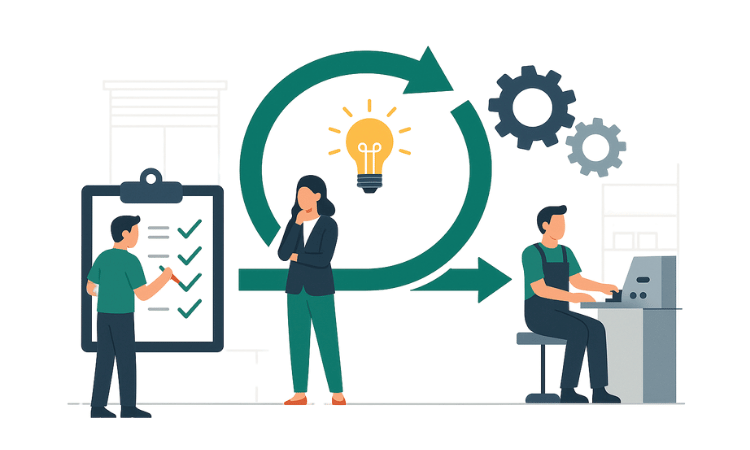
Lean vs. Six Sigma Methodologies
Although often used together, Lean and Six Sigma started as separate methodologies with different emphases:
- Lean methodology originated in the Toyota Production System of the 1940s. Its core idea is to maximize customer value while minimizing waste. Lean focuses on identifying every step in a process that does not add value – such as defects, overproduction, waiting, excess motion, etc. – and eliminating it. These eight common wastes are often remembered by the acronym DOWNTIME (Defects, Overproduction, Waiting, Non-utilized talent, Transportation, Inventory, Motion, Extra-processing). Lean’s philosophy includes continuous improvement (Kaizen) and respect for people, meaning teams constantly refine processes to move toward “perfection” (zero waste).
- Key Lean principles (from Lean Thinking) include:
- Value: Specify value from the customer’s viewpoint.
- Value Stream: Map all steps in the process and eliminate non-value steps (waste).
- Flow: Organize remaining steps in a smooth, uninterrupted sequence.
- Pull: Let customer demand “pull” work through the process (produce only what is needed).
- Perfection: Continuously repeat the above to remove waste and improve processes.
- Six Sigma methodology started at Motorola in the 1980s. It is a data-driven approach focused on reducing variation and defects in processes. Six Sigma projects use statistical analysis to improve quality – the term “Six Sigma” itself refers to operating with only 3.4 defects per million opportunities. The heart of Six Sigma is its disciplined problem-solving cycle, commonly DMAIC (Define, Measure, Analyze, Improve, Control) for improving existing processes (or DMADV for designing new processes). Six Sigma emphasizes making decisions based on data and measurement.

In summary, Lean aims to eliminate waste and improve flow, while Six Sigma aims to reduce defects and variability with statistical rigor. Both approaches strive for more effective processes, but from different angles. As one explanation notes, Lean Six Sigma “builds on the principles of Six Sigma with a focus on efficiency,” aiming for “more effective processes that yield a bigger bottom line”. By combining Lean’s waste elimination with Six Sigma’s quality control, Lean Six Sigma provides a holistic path to process excellence.to improve processes supports the overall mission and vision of the organization.
Core Principles of Lean and Six Sigma
Lean principles center on delivering maximum value to the customer with minimal waste. In practice, Lean teams:
- Specify value from the end customer’s perspective.
- Identify the value stream, mapping all steps and eliminating those that don’t add value.
- Create flow by restructuring steps so work moves smoothly, without pauses or delays.
- Establish pull systems, where production is driven by actual demand rather than forecasts.
- Pursue continuous improvement, repeating this process to continually remove waste and get closer to a “perfect” process.
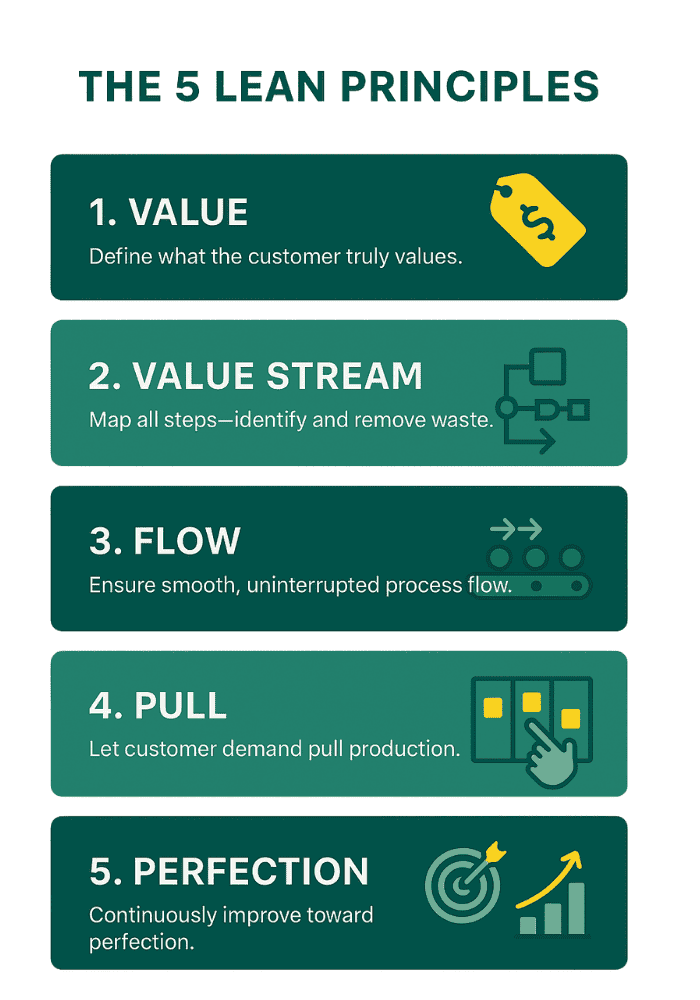
Lean tools (like 5S, value stream mapping, kanban, etc.) all support these principles by streamlining workflows and empowering teams to find waste.
Six Sigma principles emphasize data and variation reduction. Six Sigma projects follow the DMAIC roadmap:
- Define: Clarify the problem or process to improve, and understand customer needs.
- Measure: Collect data on the current process to establish a performance baseline.
- Analyze: Use statistical methods to find root causes of defects or variation.
- Improve: Develop and implement solutions to eliminate those causes.
- Control: Put controls in place (charts, procedures, training) to sustain improvements.
By following DMAIC, teams ensure rigorous analysis before acting. Six Sigma practitioners apply a range of quality tools and statistical techniques (e.g. control charts, design of experiments, regression) to make decisions based on evidence. The overall goal is clear: drive process outputs closer to the target and reduce variability so that fewer defects occur over time.
The DMAIC Improvement Cycle
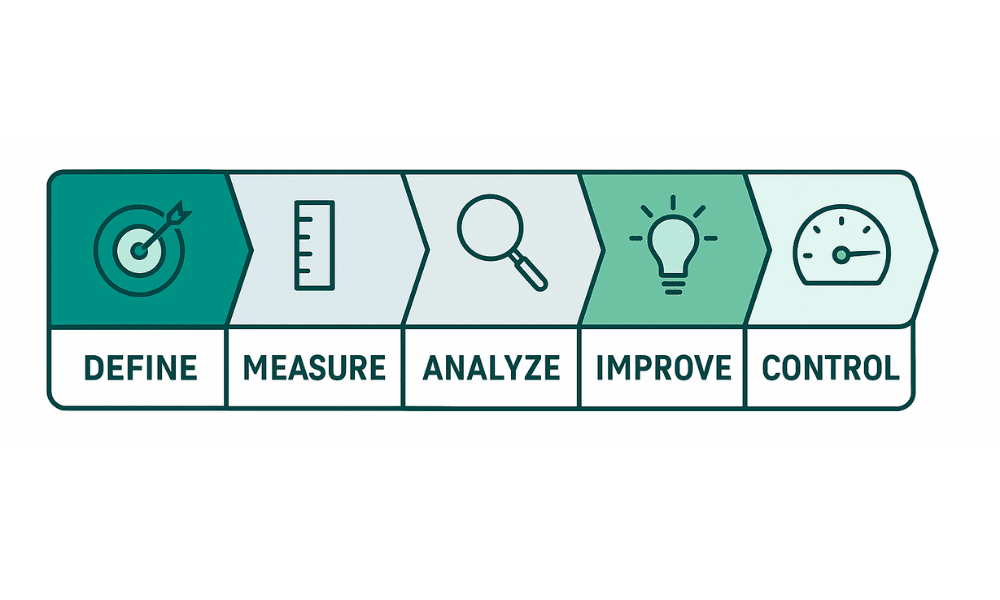
A hallmark of Lean Six Sigma is the DMAIC framework. DMAIC (Define-Measure-Analyze-Improve-Control) is a structured five-phase methodology for improving an existing process. Each phase has specific goals:
- Define: Identify the problem, project goals, and customer (internal/external) requirements.
- Measure: Quantify current performance; collect data on key process metrics.
- Analyze: Investigate data to uncover root causes of problems.
- Improve: Develop and implement solutions that address the identified causes.
- Control: Establish monitoring to ensure gains are maintained.
This framework provides a “roadmap” for Lean Six Sigma projects. As one source explains, DMAIC is a data-driven five-step method for improving and stabilizing processes. (For example, a team might define a problem with order fulfillment, measure the current cycle time and defect rates, analyze why delays occur, improve the process flow, and then implement control charts to monitor future performance.) An internal DMAIC resource provides detailed guidance on each phase.
“Six Sigma’s DMAIC phases are utilized in Lean Six Sigma. The acronym stands for define, measure, analyze, improve, and control”.
By repeatedly cycling through DMAIC (and Lean’s continuous-improvement loops), organizations can drive sustained process improvements. The DMAIC methodology helps teams break down complex problems into manageable steps, ensuring that solutions are based on careful analysis rather than guesswork.
Lean Six Sigma Certification Levels
Lean Six Sigma training is often organized by belt levels, similar to martial arts. Each belt represents a different level of training and responsibility:

- Yellow Belt: Entry-level certification for newcomers. A Yellow Belt learns basic Lean Six Sigma concepts and tools and serves as a team member on improvement projects. Yellow Belts support data collection, process mapping, and simple analysis – they have a fundamental knowledge of Six Sigma but typically do not lead projects on their own. (For example, a Yellow Belt might help a Black Belt gather measurement data or create a process flowchart.) LearnLeanSigma’s Yellow Belt guide covers these fundamentals in detail.
- Green Belt: Mid-level practitioners who typically lead smaller-scale projects under the guidance of a Black Belt. Green Belts have more extensive training in Lean Six Sigma tools and handle day-to-day improvement tasks, analyzing data and implementing solutions. They often split time between process improvement work and their regular job duties.
- Black Belt: Advanced experts who lead complex projects and improvement programs. Black Belts have deep training in statistics, Lean techniques, and change management. They often mentor Green Belts and drive strategic initiatives to improve major processes across an organization.
Above Black Belt, some organizations have Master Black Belts (experts who coach others and oversee the entire Lean Six Sigma program).
For beginners, the Yellow Belt level is the starting point. As the Council for Six Sigma Certification explains, a certified Yellow Belt has “basic knowledge of Six Sigma” and typically participates as a core team member on projects. Yellow Belts often help develop process maps and may lead very limited “PDCA” (Plan-Do-Check-Act) improvement tasks. In contrast, Green Belts and Black Belts take on bigger responsibilities: Green Belts lead projects under supervision, and Black Belts manage large-scale improvements. are involved in problem-solving, supported by leadership respect and a sense of shared responsibility.
Essential Lean Six Sigma Tools
Lean Six Sigma employs a variety of tools to analyze processes and solve problems. Beginners should be familiar with these key tools:

- Fishbone (Ishikawa) Diagram: A visual tool for root-cause analysis. It looks like a fish skeleton and categorizes potential causes of a problem (e.g. People, Process, Equipment, Materials). A fishbone diagram helps teams systematically brainstorm and organize causes under major headings. As ASQ notes, “A fishbone diagram… is a quality tool that helps users identify the many possible causes for a problem by sorting ideas into useful categories”. (See the internal Fishbone Diagram guide for examples.)
- Control Chart: A statistical graph used to monitor process stability over time. Data (such as defect rates or cycle times) are plotted in time order, with a central line for the average and upper/lower control limits based on historical variation. By comparing new data against these limits, teams can tell if a process is in control or if special causes are affecting it. Control charts are a staple of Six Sigma’s quality control toolkit. (See Control Charts guide for how to use them.)
- Pareto Chart: A bar chart that highlights the most significant factors in a dataset. Based on the “80/20 rule,” a Pareto chart helps teams focus on the vital few causes that contribute to most of the problem. It ranks categories (e.g. defect types) from highest to lowest frequency or cost. As one explanation states, a Pareto chart “is one of the key tools used in total quality management and Six Sigma,” displaying each cause’s “cost” so the most significant issues stand out. (Learn more in the Pareto Chart guide.)
- 5 Whys Analysis: A simple but powerful technique for finding root causes. The team asks “Why?” iteratively (often five times) in response to a problem statement, drilling down through layers of symptoms until reaching the fundamental cause. By uncovering the root cause, teams can address the underlying issue instead of just treating surface-level symptoms. LearnLeanSigma’s 5 Whys guide walks through this process.
- Additional Tools: Lean Six Sigma also uses many other tools, such as SIPOC diagrams (mapping Suppliers, Inputs, Process, Outputs, Customers), process flowcharts, histograms, scatter plots, failure mode and effects analysis (FMEA), and Value Stream Mapping (to visualize and optimize entire workflows). Beginners will typically learn and apply these tools as part of training programs.
Each tool has a specific purpose: fishbone diagrams and 5 Whys for root-cause analysis; Pareto charts to prioritize problems; control charts to monitor process behavior; value stream maps to redesign workflows; etc. As an example, a team investigating frequent order delays might use a fishbone diagram to list potential causes, a Pareto chart to identify the biggest issues, and a control chart to track improvement over time.s, “Substantial research… indicates that American industries are actively implementing Lean Manufacturing as a key strategy for remaining competitive”. Wherever it’s applied, lean drives continuous gains: as one Toyota expert put it, lean produces a “culture of waste elimination” in which each improvement leads to the next.
Conclusion

In summary, Lean Six Sigma is a comprehensive improvement methodology that blends Lean’s waste-elimination methods with Six Sigma’s data-driven quality management. It teaches organizations to focus relentlessly on customer value, remove all unnecessary waste (the Lean way), and to use statistical analysis to reduce defects and variability (the Six Sigma way). Projects follow a disciplined DMAIC cycle for solving problems in five phases. Practitioners earn Yellow, Green, or Black Belt certifications as they gain skills in tools like process mapping, fishbone diagrams, Pareto charts, and control charts. For beginners, achieving a Yellow Belt is a great start: you’ll learn foundational Lean Six Sigma concepts and how to support real projects.
By applying Lean Six Sigma principles and tools, teams can make processes faster, cheaper, and higher-quality all at once. The result is not just cost savings, but processes that consistently meet customer needs with minimal waste. As you explore Lean Six Sigma, remember that its goal is “to create efficiencies by identifying the causes of waste and redundancy and developing solutions to address them”. Armed with this philosophy, even beginners can drive meaningful improvements in any organization.
References
- American Society for Quality (ASQ). (n.d.). Fishbone Diagram (Cause and Effect Diagram). [online] Available at: https://asq.org/quality-resources/fishbone [Accessed 3 May 2025].
- ASQ. (n.d.). Control Charts. [online] Available at: https://asq.org/quality-resources/control-chart [Accessed 3 May 2025].
- Carnegie Mellon University. (n.d.). Introduction to Six Sigma. [online] Available at: https://www.cmu.edu/lean-six-sigma/index.html [Accessed 3 May 2025].
- Council for Six Sigma Certification. (n.d.). What is a Yellow Belt? [online] Available at: https://www.sixsigmacouncil.org/yellow-belt-certification/ [Accessed 3 May 2025].
- GoLeanSixSigma. (n.d.). DMAIC – The 5 Phases of Lean Six Sigma. [online] Available at: https://goleansixsigma.com/dmaic-five-basic-phases-of-lean-six-sigma/ [Accessed 3 May 2025].
- Investopedia. (2022). Lean Six Sigma: Definition, Principles, and Benefits. [online] Available at: https://www.investopedia.com/terms/l/lean-six-sigma.asp [Accessed 3 May 2025].
- Pareto Chart Tool. (n.d.). What is a Pareto Chart? [online] Available at: https://www.mindtools.com/a6j6xr0/pareto-analysis [Accessed 3 May 2025].
- Purdue University. (n.d.). What is Lean Six Sigma? [online] Available at: https://www.purdue.edu/leansixsigma/ [Accessed 3 May 2025].
- Womack, J.P. and Jones, D.T. (1996). Lean Thinking: Banish Waste and Create Wealth in Your Corporation. New York: Simon & Schuster.
