How to Do a PDCA (Without Going in Circles): A Practical Guide to Continuous Improvement
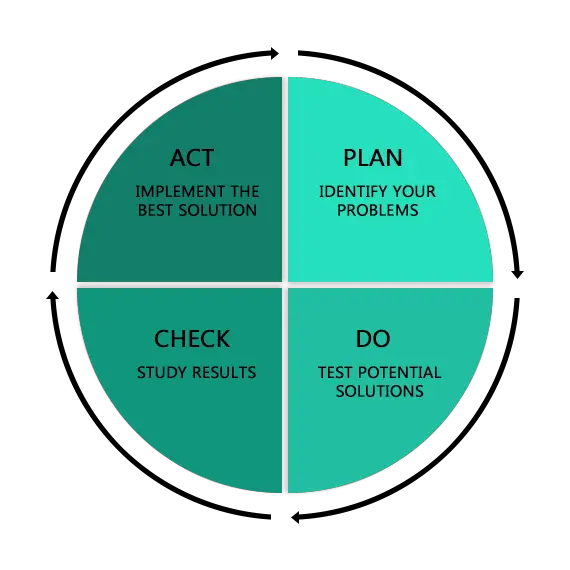
Ever feel like you’re solving the same problem over and over again? You fix one issue, celebrate, then a week later—boom—it’s back like a workplace version of déjà vu. If that sounds familiar, you’re not alone. Many teams jump straight into action without checking if the root cause has really been solved—or if they even understood the problem to begin with.
That’s where PDCA comes in.
This post breaks down what PDCA actually is (not just what the acronym stands for), how to do it properly, and why it’s so foundational to real, sustainable change. Whether you’re dealing with quality issues, process inefficiencies, or a stubborn bottleneck that just won’t budge, this cycle is your go-to problem-solving sidekick. Let’s look at how to use it—without getting stuck going in circles.
What is PDCA and Why Does It Matter?

PDCA stands for Plan–Do–Check–Act, but it’s much more than a neat four-letter framework. It’s a structured, repeatable approach to problem-solving that drives learning, improvement, and results—without the chaos of guesswork or the drama of knee-jerk reactions.
The concept dates back to the work of Walter Shewhart and was popularized by W. Edwards Deming (who you might say made continuous improvement cool before it was cool). PDCA was originally called the Shewhart Cycle, but let’s be honest—that doesn’t roll off the tongue quite as nicely.
In Lean environments, PDCA underpins everything from Kaizen events to A3 reports and daily problem-solving. It’s what turns “let’s try something” into “let’s solve this for good.”
Here’s the key: PDCA isn’t meant to be done once. It’s a cycle. That means even if you don’t get it right the first time, the process helps you learn, adapt, and iterate until you do. It’s Lean’s version of debugging—without the IT ticket.
How to Actually Do a PDCA (And Not Just Talk About It)
Let’s walk through each part of PDCA with practical steps, useful tools, and a few “rookie mistakes” to avoid. This is where PDCA goes from theory to real-world action.
🧠 Plan
This is where most people think they’re being methodical—when really, they’re often just winging it with a Post-it note and some good intentions.
In this phase, you:
- Define the problem clearly – Use tools like 5W1H or SIPOC to understand the full picture.
- Gather data – Not just opinions! Baseline performance is key.
- Identify root causes – Use Fishbone Diagrams or 5 Whys to get to the core of the issue.
- Set measurable goals – SMART goals only. “Improve quality” is vague; “Reduce defects from 7% to 3% in 4 weeks” is PDCA-ready.
- Design countermeasures – Think small, testable, and focused.
🧠 Plan
Problem Statement:
High machine downtime in Line 3 due to frequent belt failures.
Root Cause:
Lack of preventive maintenance schedule and worn-out belts not being replaced proactively.
Goal (SMART):
Reduce downtime on Line 3 by 25% within the next 3 months.
📌 Tip: Don’t rush this. The better your planning, the less likely you’ll end up back at square one—again.
🛠 Tools to use: A3 Thinking, Project Charters, FMEA, SIPOC, Fishbone Diagrams.
🛠 Do
This is your “trial run.” You’re not changing the world here—just testing your plan under controlled conditions.
During this phase:
- Implement your countermeasures – Preferably as a pilot or small-scale test.
- Stick to the plan – No improvising halfway through.
- Document the process – What worked, what didn’t, any hiccups along the way.
🛠 Do
Countermeasure:
Implement a weekly maintenance checklist and replace belts every 30 days.
Responsible Person:
Maintenance Supervisor – Sarah Lopez
Start Date:
March 25, 2025
📌 Tip: Keep it tight. Big changes too early = big headaches later.
🛠 Tools to use: Standard Work Instructions, Pilot Plans, Checklists, Task Assignments.
📊 Check
Now we separate the hype from the results.
Ask yourself:
- Did the change produce the intended result?
- What do the numbers say? Compare your new data to your baseline.
- What did people observe? Get qualitative feedback too.
- Were there any unexpected outcomes?
📊 Check
Results Achieved:
Downtime reduced from 16 hours/month to 11 hours/month in the first 2 months.
Was the goal met?
Partially
📌 Tip: Don’t trust your gut—trust the data. Your gut isn’t Six Sigma certified.
🛠 Tools to use: Control Charts, KPIs, Before/After Dashboards, Voice of the Process reports.
🔄 Act (or Adjust)
Now you decide:
- If the change worked → standardize it, roll it out, update procedures, and train teams.
- If it didn’t work → tweak your approach based on what you learned, and run another PDCA cycle.
🔄 Act
Next Action:
Repeat cycle with adjustments.
Lessons Learned:
Preventive actions improved uptime, but further training is needed to ensure consistent checklist use by night shift.
📌 Tip: The “Act” phase is often skipped, but it’s the bridge between trial and transformation.
🛠 Tools to use: Standard Operating Procedures (SOPs), Communication Plans, Training Sheets, Lessons Learned Logs.
Common Mistakes to Avoid:
- Failing to document what was learned (so nobody else benefits).
- Planning too vaguely (“Improve process” ≠ actionable)
- Skipping the Check phase and just “hoping for the best”
- Treating PDCA as a one-and-done instead of an iterative cycle
One Cycle is Not Enough — Making PDCA a Habit
So, you’ve completed a full PDCA cycle. The problem’s addressed, the downtime is down, and everyone’s high-fiving in the breakroom. Great! Now do it again.
That’s the beauty—and the trap—of PDCA. It’s not a “fix it and forget it” tool. It’s a mindset. The “C” and “A” (Check and Act) aren’t just wrap-up tasks; they’re springboards to the next iteration. When teams treat PDCA as a one-off, they lose out on its real power: compounding improvement.
Here’s how to bake PDCA into your day-to-day operations without overwhelming your team (or yourself):
✅ Start Small and Daily
Integrate mini PDCA loops into daily stand-up or Gemba meetings. Did an issue pop up yesterday? Plan a quick countermeasure, test it today, and check the results tomorrow. No forms required—just structure.
Example: In a morning meeting, the team notes a delay due to missing tools. They plan to introduce a shadow board by lunch, install it, then check tool availability the next day.
🧰 Visualize the Cycle
Make your PDCA cycles visible. Use a whiteboard or digital tracker to show what stage each improvement is in. This builds accountability and momentum.
- Columns: Plan | Do | Check | Act | Standardized
- Cards: One per improvement idea
- Bonus: Add owner and due date fields
👥 Make It a Team Sport
Don’t make PDCA the Lean team’s secret weapon. Coach supervisors and operators to run their own small cycles. The more people who can identify problems and act, the more resilient your processes become.
Encourage simple reflection questions:
- What did we try yesterday?
- Did it work?
- What’s our next step?
🔄 Loop and Layer
Your first PDCA might improve something by 10%. But your second can stack on top of that. And the third? Even better. Over time, these small wins snowball into significant breakthroughs. That’s why continuous improvement isn’t just a buzzword—it’s a strategy.
Conclusion
PDCA might sound simple—Plan, Do, Check, Act—but don’t let that fool you. It’s one of the most powerful (and underrated) tools in the Lean toolbox. When used correctly, it helps teams solve problems systematically, test ideas safely, and build momentum with each iteration.
To recap:
- Plan: Understand the problem, set clear goals, and think before acting.
- Do: Implement your solution—small scale, high learning.
- Check: Measure what happened versus what you expected.
- Act: Lock in the win or adjust and go again.
The magic lies in repetition. Each cycle teaches you something. Each loop gets you closer to better.
So—what’s one issue you could PDCA this week? Pick something small. Run through the cycle. Then, do it again. Improvement doesn’t need fireworks. Just a little discipline and a plan.
References
- Isniah, S., Purba, H.H. and Debora, F., 2020. Plan do check action (PDCA) method: literature review and research issues. Jurnal Sistem dan Manajemen Industri, 4(1), pp.72-81.
