Master the 5S Audit: A Step-by-Step Guide to Sustained Workplace Organization
Picture this: You’re on the shop floor, and chaos reigns. Tools are misplaced, unnecessary materials clutter the aisles, and valuable time is wasted searching for essentials. If that sounds familiar, don’t worry—you’re not alone. This is exactly what the 5S methodology aims to fix.
But here’s the catch: implementing 5S is only the beginning. Without regular audits, even the best-organized workplaces can slip back into old habits faster than you can say, “Where did that wrench go?” That’s where a 5S audit comes in—a structured process designed to keep your improvements on track, find areas for improvement, and prevent backsliding into clutter and inefficiency.
In this post, we’ll break down how to conduct a successful 5S audit, from preparation and scoring to follow-up actions. Whether you’re just starting out or need to refresh your 5S process, you’ll walk away with actionable tips to keep your workplace running like a well-oiled machine.

Understanding the Purpose of a 5S Audit
A 5S audit isn’t just a formality; it’s your ongoing insurance policy against inefficiency. Think of it like routine maintenance for your car—neglect it for too long, and things will start to break down. But when done right, a 5S audit can be the key to maintaining long-term improvements and uncovering hidden issues before they snowball into major problems.
Here’s what you need to know:
- What is a 5S Audit?
A structured evaluation of how well your work areas follow the 5S methodology:- Sort (Seiri): Removing what’s not needed
- Set in Order (Seiton): Organizing what’s left
- Shine (Seiso): Cleaning and maintaining
- Standardize (Seiketsu): Establishing best practices
- Sustain (Shitsuke): Maintaining and improving over time

- Why Conduct a 5S Audit?
- To ensure 5S improvements don’t fade over time.
- To catch and correct small inefficiencies before they lead to bigger problems.
- To continuously identify opportunities for improvement, whether it’s optimizing tool placement or streamlining daily tasks.
- When Should You Do a 5S Audit?
- Initial audit: Conducted right after 5S implementation to establish a baseline.
- Regular audits: Weekly, monthly, or quarterly, depending on the process and its complexity.
- Special audits: After major changes or process updates to ensure new standards are being met.
A well-timed audit keeps teams accountable and motivated. It also demonstrates that 5S isn’t just a one-off initiative but an integral part of your continuous improvement strategy. In the next section, we’ll cover how to prepare for your audit to ensure success from the start.
Preparing for a 5S Audit
The success of a 5S audit often depends on the preparation before it even begins. Skipping this step is like heading out on a road trip without a map—you’ll eventually get somewhere, but it might not be where you want to be. With the right preparation, your audit will be smooth, efficient, and result-oriented.
Here’s how to set the stage for success:
1. Define Your Audit Criteria
You can’t measure success without knowing what success looks like. Establish clear standards for each of the 5S pillars so that everyone involved in the audit is working from the same playbook.
- Tip: Use a pre-designed 5S audit checklist with specific questions for each “S” to evaluate performance consistently. For example:
- Sort: Are unnecessary items removed from the workspace?
- Set in Order: Are tools and materials organized in clearly designated locations?
- Shine: Is the area clean, and is there a maintenance plan in place?
Consider using our 5S Audit Template to get you started

2. Assemble Your Audit Team

The more eyes on the process, the better. But you don’t want just any random group of people—your team should represent a cross-section of departments to bring diverse perspectives and spot issues others might overlook.
- Tip: Rotate audit team members regularly to prevent them from becoming too familiar with the environment, which could lead to blind spots.
3. Train the Audit Team
Even experienced team members benefit from a refresher on the 5S principles and how to conduct an objective, thorough audit. Training ensures that every auditor knows:
- What to look for during the audit
- How to identify non-compliance and improvement opportunities
- How to score consistently using your criteria
- Tip: Consider a short pre-audit walkthrough with the team to point out common issues like misplaced tools, unclean equipment, or cluttered areas.
4. Set the Audit Scope and Schedule
Are you auditing a specific area, department, or the entire facility? Setting clear boundaries for what will be audited ensures that time and resources are used efficiently.
- Tip: If possible, vary the scope of your audits over time. Some audits can focus on individual areas (micro-level), while others might assess an entire production line or department (macro-level).
5. Prepare Visual Tools for Reference
Visual aids like process maps, workstation layouts, and “before and after” photos can be valuable references during the audit. They help highlight inconsistencies and areas that may need corrective action.

By taking the time to prepare thoroughly, you’ll ensure that your audit isn’t just a box-ticking exercise but a powerful tool for identifying waste and boosting workplace efficiency. Next, we’ll dive into the actual auditing process and how to make it as effective as possible.
Conducting the 5S Audit
With preparation done, it’s time to hit the floor and conduct the audit. The goal isn’t to point fingers or overwhelm teams with a list of failures—it’s about identifying gaps and opportunities for improvement in a constructive way. Here’s a step-by-step breakdown of the audit process for each 5S stage:
1. Sort (Seiri) – Eliminate the Unnecessary
Objective: Ensure that only the tools, materials, and equipment necessary for the job are present.
What to Look For:
- Are obsolete, broken, or unnecessary items removed from the workspace?
- Is there any equipment or material sitting unused for long periods?
- Are storage areas cluttered with items that don’t belong?
Key Tip: Use colored tags (often called red tags) to mark unnecessary items. These tags make it easy to identify and track what should be removed or relocated.
2. Set in Order (Seiton) – Organize for Efficiency
Objective: Ensure that everything has a designated place and can be accessed quickly.
What to Look For:
- Are tools and materials clearly labeled and stored in designated locations?
- Are frequently used items easy to access without excessive searching or movement?
- Is the workstation layout logical and optimized for workflow efficiency?
Key Tip: Verify that shadow boards, labeled shelves, and tool outlines are in place and being used correctly. If employees are still searching for tools, adjustments may be needed.
3. Shine (Seiso) – Maintain Cleanliness
Objective: Check for cleanliness and ensure regular cleaning routines are followed.
What to Look For:
- Are machines, tools, and floors clean and free of dust, debris, and oil spills?
- Are there any areas where accumulated dirt or mess indicates neglect?
- Are cleaning supplies easily accessible and properly stored?
Key Tip: Check for preventive maintenance measures as part of Shine. Clean environments help reveal issues like leaks, wear, or equipment damage early on.
4. Standardize (Seiketsu) – Ensure Consistency
Objective: Make sure that standards for sorting, organizing, and cleaning are consistently applied across teams and shifts.
What to Look For:
- Are standard operating procedures (SOPs) posted and followed?
- Are visual guides (such as cleaning schedules or workstation layouts) displayed and up to date?
- Are consistent labeling systems being used across work areas?
5. Sustain (Shitsuke) – Maintain and Improve
Objective: Ensure that 5S practices are embedded in daily routines and that teams are continuously improving.
What to Look For:
- Are regular 5S audits scheduled and documented?
- Are team members actively involved in maintaining 5S standards?
- Are new ideas or improvements being suggested and implemented over time?
Key Tip: Check for signs of stagnation, such as repeated issues from previous audits or a lack of engagement. Recognize and reward teams that consistently meet or exceed standards to maintain motivation.
Scoring and Documentation
- Use a scoring system: Rate each “S” on a scale (e.g., 1-5) or use color-coded visual indicators (green for compliant, red for non-compliant).
- Take photos: Capture before-and-after images to track improvements.
- Record findings: Use an audit checklist or digital tool to document observations, issues, and recommended actions.
Once the audit is complete, it’s time to analyze the results and turn them into actionable improvements. That’s what we’ll cover in the next section.
Scoring and Turning Audit Results Into Action
Completing the 5S audit is just the beginning. What really matters is how you interpret the results and take action to correct issues and drive improvements. Here’s how to do it effectively:
1. Score Each 5S Category
Use a simple and consistent scoring system to measure compliance with 5S standards. Here are some common options:
- Numerical scoring system: Rate each “S” on a scale (e.g., 1 to 5, with 1 being non-compliant and 5 being excellent).
- Color-coded system: Green for areas that meet standards, yellow for areas needing minor improvement, and red for areas requiring immediate attention.
Tip: Keep your scoring simple and actionable. Don’t get bogged down in complex calculations—focus on identifying key problem areas.
2. Analyze Audit Results
After scoring, it’s time to dive into the data to understand patterns, trends, and root causes of non-compliance.
Look for:
- Recurring issues: Are there areas that consistently score low across audits?
- High-priority issues: Are there any red-flag areas that could lead to safety hazards or production delays?
- Successes: Celebrate areas that have shown sustained improvement or exceeded standards.
Tip: Consider creating a summary report that highlights major findings and trends over time. This helps identify whether improvements are being sustained or if additional training and resources are needed.
3. Develop an Action Plan
For every problem identified during the audit, develop an action plan with clear corrective steps, responsibilities, and deadlines.
For this you can consider our 5S Audit trend and action plan template.
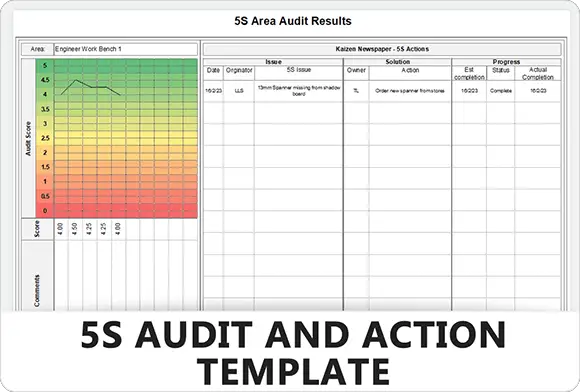
Key Elements of the Action Plan:
- What needs to be done: Describe the specific action (e.g., reorganize tool storage, clean a specific area, create a visual guide).
- Who is responsible: Assign an individual or team to implement the improvement.
- When it should be completed: Set a realistic deadline for completion.
- Follow-up plan: Schedule a date for the next audit or follow-up check to ensure the corrective action was successful.
Tip: Use digital tools or a shared document to track the action plan and update progress in real-time. Visibility and accountability are crucial for long-term success.
4. Implement Immediate Improvements
Some audit findings may require long-term fixes, but quick wins should be addressed immediately. For example:
- Clearing clutter and unused materials (Sort)
- Re-labeling storage areas for clarity (Set in Order)
- Cleaning machines and workstations on the spot (Shine)
Tip: Immediate improvements can serve as a morale booster and show employees that the audit isn’t just about pointing out problems—it’s about making real-time changes that improve their work environment.
5. Monitor Progress and Conduct Follow-Up Audits
After implementing changes, monitor progress through follow-up audits. The goal is to ensure that corrective actions have been effective and that improvements are sustained over time.
Best Practices for Follow-Up:
- Review the previous audit results to see if problem areas have improved.
- Involve team members in discussing what went well and what needs further adjustment.
- Keep a record of progress through before-and-after photos and updated scores.
By analyzing results, taking action, and following up, you’ll transform the 5S audit from a one-time event into a continuous improvement cycle.
Conclusion
A 5S audit isn’t just a checklist—it’s a powerful tool for maintaining workplace efficiency, eliminating waste, and continuously improving processes. By preparing thoroughly, conducting detailed evaluations, and acting on audit results, you can create a sustainable cycle of improvement that benefits everyone on the team.
Remember, the key to long-term success is consistency. Regular audits, action plans, and follow-up checks will prevent backsliding into bad habits and keep your organization running like a well-oiled machine. Celebrate small wins to keep teams motivated, and use each audit as a learning opportunity.
