Many businesses struggle with setting a clear direction. Some rely on gut feelings, while others create plans that collect dust on a shelf. Without a well-defined strategy, teams waste time on misaligned priorities, resources are spread too thin, and competitors pull ahead.
But strategy doesn’t have to be complicated. There are proven methods to help businesses craft a clear, actionable plan for success. Whether you’re leading a startup, running an established company, or optimizing operations, the right approach can turn vague ambitions into focused execution.
In this post, we’ll explore five powerful strategy creation methods:
- Hoshin Kanri (Policy Deployment)
- SWOT Analysis
- Balanced Scorecard
- Blue Ocean Strategy
- Porter’s Five Forces
Each method has its strengths and is best suited for different situations. Let’s dive into how they work and when to use them.
Hoshin Kanri (Policy Deployment)
Hoshin Kanri, also known as Policy Deployment, is a structured approach to strategic planning that ensures company-wide alignment. Instead of vague goals or top-down mandates that get lost in translation, Hoshin Kanri connects high-level objectives with daily activities.
This method uses the X-Matrix, a visual tool that links long-term strategic goals to annual objectives, key initiatives, and the people responsible for execution. It ensures that everyone—from executives to frontline employees—understands how their work contributes to the company’s success.

When to Use Hoshin Kanri:
- Your organization needs a clear, long-term direction.
- You want to align every level of the business with strategic goals.
- You need a structured, systematic approach to tracking execution.
Example: A manufacturing company aiming to reduce lead times by 30% in three years would use Hoshin Kanri to break this goal into annual objectives, define key improvement projects, and assign accountability at every level.
This method prevents strategic drift, ensuring that daily actions contribute directly to the bigger picture.
SWOT Analysis
SWOT Analysis is a straightforward yet effective tool for assessing a business’s internal and external environment. It identifies:
- Strengths – What the business does well.
- Weaknesses – Areas needing improvement.
- Opportunities – External trends that could be leveraged.
- Threats – Risks that could hinder success.
By mapping these factors, businesses can make informed strategic decisions, capitalize on advantages, and mitigate risks.

When to Use SWOT Analysis:
- You need a quick and structured way to assess your business.
- You want to identify opportunities and threats before making big decisions.
- You’re in the early stages of strategic planning and need a high-level view.
Example: A tech startup planning to launch a new product might use SWOT to analyze its strengths (innovative features), weaknesses (limited brand recognition), opportunities (growing market demand), and threats (strong competitors).
SWOT is simple but powerful—it highlights the biggest factors influencing your business and helps you build a strategy that plays to your strengths.
Balanced Scorecard
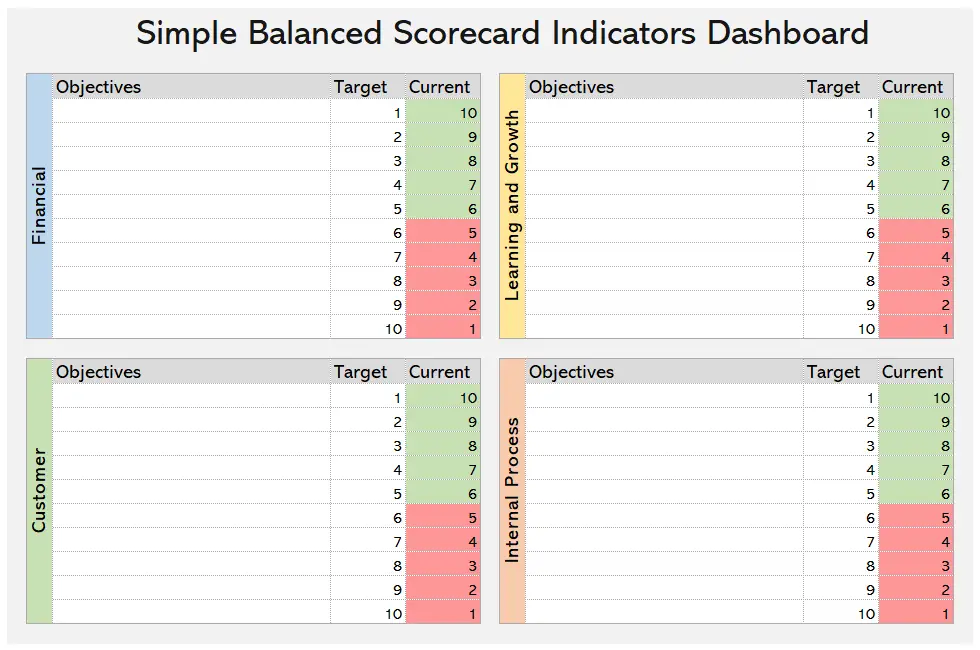
The Balanced Scorecard (BSC) is a strategic framework that goes beyond financial performance to provide a holistic view of an organization’s success. It ensures that companies focus on key areas that drive long-term sustainability, rather than just short-term profits.
Developed by Robert Kaplan and David Norton, the Balanced Scorecard evaluates strategy through four key perspectives:
- Financial – How do we measure success for shareholders?
- Customer – How do customers perceive our business?
- Internal Processes – What processes must we excel at?
- Learning & Growth – How do we sustain improvement and innovation?
Each perspective is linked to strategic objectives, key performance indicators (KPIs), and action plans, ensuring that all aspects of the business contribute to overall success.
When to Use the Balanced Scorecard:
- You need a comprehensive framework to measure and guide strategy.
- Your business wants to align financial and non-financial goals.
- You need a structured way to track performance across multiple areas.
Example: A healthcare provider might use the Balanced Scorecard to track financial sustainability, patient satisfaction, operational efficiency, and staff development, ensuring that success isn’t measured by revenue alone but also by service quality and employee engagement.
BSC helps businesses stay balanced—ensuring they’re not just growing, but growing in the right way.
Blue Ocean Strategy
Blue Ocean Strategy focuses on creating uncontested market space instead of battling competitors in an existing, saturated industry. Rather than fighting over a shrinking pie, businesses using this strategy make a new pie altogether.
Coined by W. Chan Kim and Renée Mauborgne, this approach encourages companies to differentiate themselves through innovation and value creation, rather than price wars and incremental improvements.
Key Concepts of Blue Ocean Strategy:
- Value Innovation – Simultaneously increasing value for customers while reducing costs.
- Eliminate-Reduce-Raise-Create (ERRC) Framework – A structured way to rethink industry norms.
- Breaking Industry Boundaries – Looking beyond traditional markets to serve unmet needs.
When to Use Blue Ocean Strategy:
- You’re stuck in intense competition and want a way out.
- Your industry is dominated by price wars with little differentiation.
- You want to create a unique value proposition and redefine market expectations.
Example: Cirque du Soleil reinvented the traditional circus by eliminating expensive elements like animals, reducing reliance on star performers, and creating a theatrical experience that attracted adults, not just children. They carved out a new market space rather than competing with traditional circuses.
Blue Ocean Strategy is about standing out rather than blending in—a powerful tool for businesses looking to innovate.
Porter’s Five Forces
Michael Porter’s Five Forces framework is a tool for analyzing industry competition and profitability. Unlike SWOT, which looks at internal and external factors, Five Forces focuses entirely on external market pressures that impact strategy.
The five forces are:
- Industry Rivalry – How intense is competition among existing players?
- Supplier Power – How much influence do suppliers have on pricing and availability?
- Buyer Power – How much control do customers have over pricing and product choices?
- Threat of New Entrants – How easy is it for new competitors to enter the market?
- Threat of Substitutes – Are there alternative solutions that could replace your product/service?
When to Use Porter’s Five Forces:
- You need to assess market competition before launching a product or expanding.
- Your industry is facing increasing pressure from new players or substitutes.
- You want to develop a strong competitive advantage by understanding external threats.
Example: A coffee chain entering a new city might use Porter’s Five Forces to evaluate the level of competition, supplier dependencies, customer preferences, and potential threats from substitute products like energy drinks.
This method helps businesses stay ahead of competitive threats by understanding the external forces shaping their industry.
Conclusion
Each of these five strategy creation methods—Hoshin Kanri, SWOT Analysis, Balanced Scorecard, Blue Ocean Strategy, and Porter’s Five Forces—offers a unique way to develop a winning business strategy.
- If you need structured, long-term alignment, use Hoshin Kanri.
- If you want a quick internal and external assessment, go with SWOT.
- If you need a balanced approach to tracking strategy, try the Balanced Scorecard.
- If you want to break away from competition, Blue Ocean Strategy is your tool.
- If you need to analyze market competition, Porter’s Five Forces will guide you.
The key to success is choosing the right tool for the right situation.
References
- Witcher, B. and Butterworth, R., 1999. Hoshin kanri: how Xerox manages. Long range planning, 32(3), pp.323-332.
