
Mastering Standard Work Instructions: The Key to Consistent Performance and Continuous Improvement
When was the last time a task didn’t go according to plan on your shop floor? Maybe Operator A completed it perfectly, while Operator B caused defects, delays, or rework. The difference likely wasn’t due to skill or effort—it’s often the absence of clear, standardized instructions.
Standard Work Instructions (SWI) are not just another form of documentation—they’re the cornerstone of lean operations, ensuring consistency, reducing errors, and creating a reliable foundation for continuous improvement. Whether you’re introducing new processes or trying to fix recurring issues, properly written SWI can be the game-changer you need.
In this post, we’ll walk you through how to craft effective SWI that actually get followed—from breaking down processes step by step to integrating visuals and safety measures. By the end, you’ll have the know-how to create instructions that minimize mistakes, speed up training, and keep performance on track.
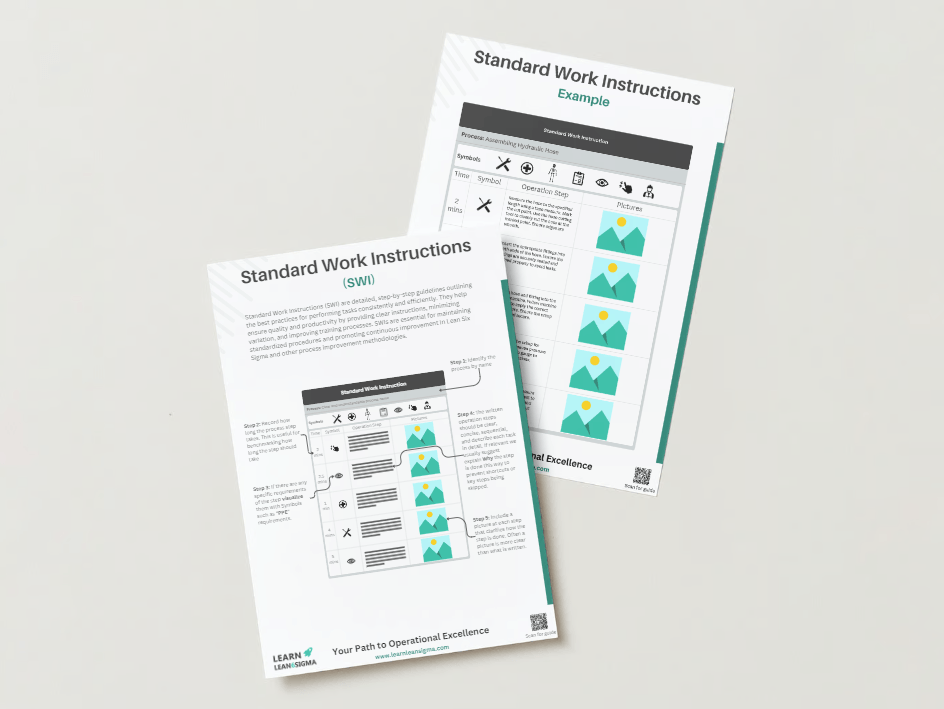
What Are Standard Work Instructions: The Foundation of Lean Success
Before diving into how to write them, let’s cover why Standard Work Instructions (SWI) are so important—and how they differ from other forms of documentation like Standard Operating Procedures (SOPs).
What Are Standard Work Instructions (SWI)?
SWI provide detailed, step-by-step guidance on how to perform a task correctly, efficiently, and safely. Think of them as the “how-to manual” for daily operations on the shop floor, with an emphasis on repeatable quality and minimized waste.
Unlike SOPs, which often focus on broader procedural guidelines, SWI zoom in on task-specific instructions that operators need to follow. For example:
- SOP: “Conduct the machine calibration procedure once per shift.”
- SWI: “Step 1: Turn off the machine. Step 2: Attach calibration tool…”

Why Are SWI Crucial for Lean and Continuous Improvement?
Continuous Improvement: SWI create a baseline, making it easier to identify areas for improvement and optimize performance.mprovement strategy. In the next section, we’ll cover how to prepare for your audit to ensure success from the start.
Consistency: SWI eliminate variability by ensuring every operator performs tasks the same way, every time.
Error Reduction: Clear instructions reduce the risk of mistakes and defects.
Operator Training: New operators get up to speed faster with structured guidance.
Practical Steps for Writing Effective Standard Work Instructions
Crafting Standard Work Instructions (SWI) isn’t about jotting down random steps and calling it a day. Effective SWI are precise, easy to follow, and designed to prevent errors before they occur. Here’s how to create instructions that operators will actually use:
To help you get started feel free to download our Standard Work Instructions Template

1. Identify the Process and Scope
Start by selecting a process that needs standardization. Ideally, focus on tasks that:
- Have high variability or frequent errors.
- Are critical to quality, safety, or production speed.
Define the boundaries of the instruction. For example:
- Covered: Setting up a machine, operating it, and shutting it down.
- Not Covered: Long-term machine maintenance or troubleshooting.
2. Break Down the Process into Step-by-Step Tasks
Use process mapping or flowcharts to identify each step in sequence. Be thorough—don’t assume operators will fill in missing details.
- Tip: Break down complex steps into sub-steps if needed.
- Example: “Load material” might include sub-steps such as “Inspect material for defects” and “Align material on conveyor belt.”
3. Define Key Details for Each Step
For each task, clearly specify:
- Required tools and materials.
- Expected outcome (e.g., proper alignment, correct measurements).
- Time requirements (Takt time if relevant).
- Any quality or safety checkpoints.
Example:
- Step: Tighten bolt
- Details: Use torque wrench set to 25 Nm. Verify tightness using gauge.
4. Use Clear, Simple, and Actionable Language
Avoid technical jargon and wordiness. Write in the active voice and be direct:
- Instead of: “The machine should ideally be turned off before maintenance begins.”
- Write: “Turn off the machine before performing maintenance.”
5. Incorporate Visual Aids
A picture is worth a thousand words, especially on the shop floor.
- Diagrams or photos showing correct and incorrect methods.
- Flowcharts for complex processes.
- Video links for tasks that benefit from visual demonstrations.
Pro Tip: Make visuals easily scannable—highlight key actions directly on the image when possible.
6. Highlight Safety, Quality, and Critical Control Points
Identify steps prone to mistakes or safety hazards and emphasize them with bold text, colored labels, or icons.
- Example:
- ⚠️ Caution: Ensure power is disconnected before servicing machinery.
- ✅ Quality Check: Inspect material thickness before moving to the next step.
7. Validate and Test the Instructions
Don’t assume that once it’s written, it’s perfect.
- Pilot test the SWI with experienced operators.
- Gather feedback: Were any steps unclear or too complex?
- Adjust and revise based on feedback before final rollout.
8. Standardize and Train Across Teams
Ensure everyone is on the same page by conducting brief training sessions.
- Use supervisors to check that all operators understand the SWI.
- Make it clear that any deviation from the instructions requires approval.
9. Digitize and Ensure Accessibility
Gone are the days of dusty binders sitting unused. Digitize your SWI and make them accessible via:
- Laminated printouts for quick reference.
- Tablets or screens on the shop floor.
- Cloud-based platforms for easy updates.
Common Challenges When Creating Standard Work Instructions (and How to Overcome Them)
Even with the best intentions, creating effective SWI can be challenging. Here are the most common obstacles—and practical solutions to overcome them.
Challenge 1: Resistance from Operators
Why It Happens: Operators may view SWI as unnecessary or see them as micromanagement.
The Solution:
- Involve operators in the creation process. Let them help document steps—they know the job best and will feel a sense of ownership.
- Highlight the benefits. Explain how SWI reduce mistakes, make training easier, and protect their jobs by improving efficiency.
- Recognize their contributions when improvements are made based on SWI.
Example: One company reduced operator resistance by showing defect reduction statistics after implementing SWI and rewarding teams for improvements.
Challenge 2: Overcomplicated Instructions
Why It Happens: Trying to include every detail can overwhelm the user and make instructions unusable.
The Solution:
- Keep instructions concise. Each step should describe a single action. If a step requires too much detail, consider breaking it into sub-steps or linking to another resource.
- Use bullet points and visuals to simplify text-heavy sections.
Quick Tip: Aim for SWI that can be followed without excessive reading or rechecking.
Challenge 3: Instructions Becoming Outdated
Why It Happens: Processes evolve, but the SWI aren’t updated to reflect changes.
The Solution:
- Establish a review cycle. Schedule reviews every 6-12 months or after significant process changes.
- Encourage feedback loops. Create a system for operators and supervisors to flag outdated instructions.
Example: Implement a “suggestion box” or a digital form where operators can provide improvement ideas for SWI.
Challenge 4: Limited Accessibility
Why It Happens: Instructions stored in binders or files that are hard to locate or access quickly.
The Solution:
- Digitize and centralize SWI using cloud-based systems or shop-floor tablets.
- Make physical copies available at key workstations for tasks that require frequent reference.
- Ensure instructions are indexed and searchable.
Pro Tip: QR codes on machines or equipment can link directly to the correct digital SWI.
Challenge 5: Lack of Follow-Through
Why It Happens: SWI are created but not consistently followed or monitored.
The Solution:
- Assign supervisors to audit adherence regularly.
- Incorporate SWI compliance into performance reviews or Gemba walks.
- Provide refresher training to ensure operators stay on track.
By addressing these challenges, you’ll ensure that your SWI remain relevant, practical, and a key driver of operational excellence.
Conclusion
Writing Standard Work Instructions isn’t just about documenting steps—it’s about creating a blueprint for consistency, quality, and continuous improvement. By breaking down tasks, using clear and actionable language, incorporating visuals, and regularly reviewing the instructions, you’ll ensure your SWI remain practical and effective.
Remember, the best SWI are living documents that adapt to process improvements and operator feedback. Start with a single process, involve your team, and commit to maintaining and updating instructions as your operations evolve.duction environment.
References
- Florentina Abreu, M., Pereira, A.C., Silva, A., Silva, F., Ferraz, F., Alves, A.C., Oliveira, J.A., Gomes, M., Analide, C., Cardoso, J. and Vicente, S., 2017. Collaborative process mapping to improve work instructions and standardized work. In Recent Advances in Information Systems and Technologies: Volume 1 5 (pp. 603-615). Springer International Publishing.
- Kit, I., 2013. Working instructions.
