Imagine running a factory where products are made exactly when needed, defects are caught before they reach customers, and efficiency is continuously improved—all without wasting resources. That’s the magic of the Toyota Production System (TPS).
Developed by Toyota in the mid-20th century, TPS has become the gold standard in manufacturing efficiency and is the foundation of Lean manufacturing worldwide. Its core principles—Just-in-Time (JIT) and Jidoka (automation with human intelligence)—have helped Toyota outperform competitors, reduce costs, and boost quality while eliminating waste.
But TPS isn’t just for car manufacturing. Industries like healthcare, software development, logistics, and retail have successfully applied its principles to streamline operations and improve customer satisfaction.
The Origins and Philosophy of TPS
The Toyota Production System (TPS) wasn’t created overnight—it was born out of necessity. After World War II, Toyota faced serious challenges: limited resources, financial struggles, and a need to compete with much larger American automakers. Unlike the mass-production systems in the U.S., which focused on high-volume output, Toyota needed a smarter, more efficient way to produce vehicles.
Inspired by American supermarkets—where shelves were restocked based on customer demand—Taiichi Ohno and Shigeo Shingo pioneered a system that would revolutionize manufacturing. They developed Just-in-Time (JIT) production, ensuring parts were only made when needed, reducing excess inventory and costs.
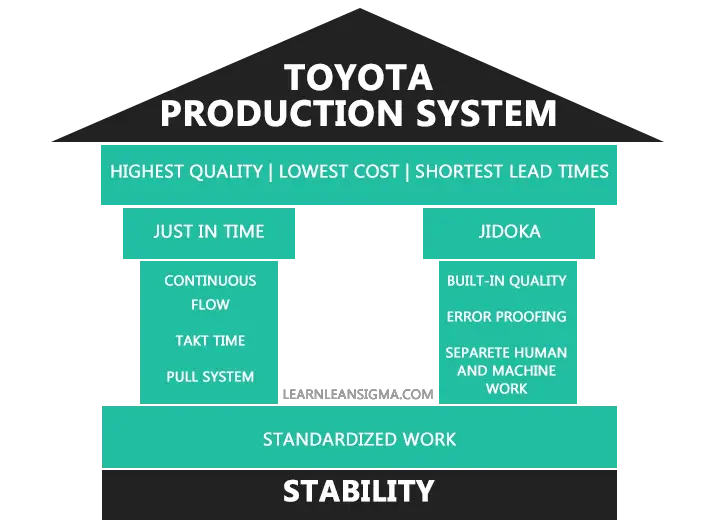
At the same time, Toyota introduced Jidoka, or “automation with a human touch.” This meant machines and employees could detect issues immediately, preventing defective products from moving down the line. Instead of mass-producing and fixing errors later, Toyota designed a system where quality was built into the process itself.
These two pillars—JIT and Jidoka—formed the foundation of TPS, leading to higher efficiency, lower costs, and better quality. More importantly, TPS wasn’t just about tools and techniques; it was a philosophy focused on continuous improvement (Kaizen) and respect for people, empowering employees to identify and solve problems.
Why TPS Matters Today
The Toyota Production System has transformed industries far beyond automotive. Companies in healthcare, retail, logistics, and even tech startups have adopted its principles to improve efficiency and eliminate waste.
The Key Principles of the Toyota Production System (TPS)
At its core, the Toyota Production System (TPS) is built on a simple yet powerful goal: maximize efficiency while eliminating waste. This isn’t just about cutting costs—it’s about creating a system that delivers high-quality products, at the right time, with the least amount of waste possible. Let’s break down the key principles that make TPS so effective.
1. Eliminating Waste (Muda, Muri, Mura)
Toyota categorizes waste into three types:
- Muda (Non-Value-Added Activities): The classic 8 Wastes of Lean, including overproduction, waiting, defects, and unnecessary motion.
- Muri (Overburden): Pushing machines or workers beyond their limits, leading to breakdowns and inefficiency.
- Mura (Unevenness): Inconsistent workloads that create bottlenecks and delays.
By addressing these, Toyota ensures a smooth, predictable workflow, reducing unnecessary costs and delays.
2. Just-in-Time (JIT) Production: Only What’s Needed, When It’s Needed
JIT is one of TPS’s defining features. Instead of stockpiling massive amounts of inventory, Toyota ensures that parts arrive exactly when they’re needed in the production process.
- This reduces storage costs, prevents waste from overproduction, and allows for more flexible, customer-driven production.
- A key tool for JIT is the Kanban system, which signals when more materials are needed, preventing shortages or excess stock.
3. Jidoka: Automation with a Human Touch
Jidoka ensures quality is built into every step of production. Instead of detecting defects at the end of the process, workers and machines are empowered to stop production immediately when a problem is found.
- This prevents defective products from moving forward, reducing rework and waste.
- Andon systems—visual indicators like lights or signals—alert teams when issues arise, ensuring quick resolution and continuous improvement.
By combining JIT (efficiency) and Jidoka (quality control), Toyota achieves an unmatched level of operational excellence.
4. Kaizen: Continuous Improvement
Kaizen is the heartbeat of TPS. It’s the idea that small, continuous improvements lead to big results over time.
- Employees at all levels are encouraged to suggest improvements, creating a culture where innovation happens daily.
- Toyota’s famous Gemba Walks—where leaders go to the production floor to observe and identify inefficiencies—ensure that decisions are made based on real-world conditions.
By making small, data-driven changes, Toyota constantly refines its processes for better efficiency, safety, and quality.
5. Heijunka: Leveling Production to Reduce Waste
Demand fluctuates, but Toyota doesn’t let that create chaos in its production lines. Heijunka (production leveling) ensures a steady, predictable workflow by:
- Balancing production schedules to avoid bottlenecks.
- Producing in small batches instead of large, inefficient runs.
- Reducing lead times while maintaining flexibility to meet customer demand.
This prevents the “feast-or-famine” cycle that many companies struggle with.
6. Standardized Work: The Foundation of Consistency
Standardization isn’t about limiting flexibility—it’s about ensuring every task is done efficiently and correctly, every time.
- Toyota uses Standard Work Instructions (SWIs) to document best practices.
- These aren’t rigid rules but are continuously improved based on Kaizen suggestions.
- Standardized processes reduce errors, improve training, and ensure consistent quality.
7. Poka-Yoke: Mistake-Proofing the Process
Toyota’s commitment to quality includes Poka-Yoke, or error-proofing, which ensures that mistakes are prevented before they happen.
By eliminating human error, Toyota reduces defects and costly rework. beyond “putting out fires”? Let’s talk about common pitfalls to avoid.
Simple mechanisms, such as jigs, sensors, or guides, help prevent defects.
Example: A plug that only fits one way prevents assembly errors.
Applications of the Toyota Production System (TPS)
The Toyota Production System (TPS) isn’t just a set of ideas—it’s a proven system that delivers results. While it was originally developed for automotive manufacturing, its principles have been successfully applied in various industries, from healthcare to logistics to software development. Let’s explore how TPS is implemented in real-world scenarios and the benefits it brings.
1. TPS in Manufacturing: The Gold Standard for Efficiency
Toyota’s factories are the ultimate example of Lean manufacturing. Every element of production is optimized to reduce waste and improve efficiency. Key implementations include:
- Just-in-Time (JIT) Systems – Parts are delivered only when needed, reducing excess inventory and freeing up cash flow.
- Kanban System – Visual cards and digital signals manage workflow, ensuring smooth production without overloading any step.
- Jidoka (Built-in Quality Control) – If an issue is detected, workers can stop production immediately to prevent defects from continuing down the line.
Example:
Toyota’s production line is so efficient that it takes only 17-18 hours to build a car from start to finish, compared to over 30 hours for some competitors.
2. TPS in Healthcare: Reducing Wait Times & Errors
Hospitals and healthcare providers have applied TPS principles to improve patient care, reduce waiting times, and prevent errors. Some examples include:
- Heijunka (Leveling Workloads): Smoothing out patient admissions to avoid overwhelming hospital staff.
- Standardized Work: Ensuring consistent patient treatment procedures to minimize mistakes.
- Poka-Yoke (Error Proofing): Using barcode scanning for medication administration to prevent dosage errors.
Example:
Virginia Mason Medical Center in the U.S. adopted TPS, reducing patient waiting times by 50% and improving surgical room efficiency—saving millions of dollars annually.
3. TPS in Logistics & Retail: Faster, Leaner Supply Chains
Retail and logistics companies have implemented TPS to streamline their supply chains and improve inventory management. They use:
- Just-in-Time (JIT) Restocking: Ensuring shelves are stocked based on customer demand, not guesswork.
- Kanban for Inventory Management: Automating reorder signals to prevent shortages or excess stock.
- Kaizen for Continuous Improvement: Encouraging warehouse employees to suggest efficiency improvements.
Example:
Amazon’s fulfillment centers use JIT principles and automation, enabling them to process and ship orders in under 24 hours with minimal inventory waste.
4. TPS in Software Development: Lean & Agile Methods
Even in non-manufacturing industries, TPS principles play a vital role. The tech industry, particularly software development, has adopted TPS under the Lean and Agile frameworks, using:
- Pull Systems (Kanban Boards): Managing software development tasks visually to prevent overloading teams.
- Continuous Improvement (Kaizen): Regular retrospectives to identify and remove bottlenecks.
- Standardized Workflows: Ensuring consistent code deployment and reducing software bugs.
Example:
Companies like Spotify and Google use Lean and Agile methods inspired by TPS, allowing them to develop faster, more reliable software with minimal waste.
5. Overcoming Challenges When Implementing TPS
While TPS is incredibly effective, many companies struggle to implement it correctly. Common challenges include:
❌ Resistance to Change – Employees and managers may cling to old ways instead of embracing Lean thinking.
✔️ Solution: Strong leadership and clear communication about the benefits of TPS.
❌ Improper Application – Companies copy TPS tools (like Kanban) without understanding the philosophy behind them.
✔️ Solution: Train employees on why each principle matters, not just how to use TPS tools.
❌ Lack of Employee Engagement – Without buy-in from front-line workers, TPS initiatives fail.
✔️ Solution: Use Kaizen events to actively involve employees in continuous improvement efforts.
Conclusion
The Toyota Production System (TPS) isn’t just a set of manufacturing techniques—it’s a mindset that prioritizes efficiency, quality, and continuous improvement. Whether it’s reducing production waste, streamlining healthcare operations, or optimizing software development, TPS principles have proven their value across industries.
The key takeaways?
✅ Eliminate waste (Muda, Muri, Mura) to improve efficiency.
✅ Just-in-Time (JIT) ensures materials and processes flow smoothly.
✅ Jidoka builds quality into the process, preventing defects early.
✅ Kaizen (Continuous Improvement) empowers employees to drive innovation.
As technology advances, TPS is evolving with it—integrating automation, AI, and data-driven decision-making to further enhance efficiency. The question isn’t if TPS can help your business, but how you can start applying its principles today.rm solutions are what save you time (and headaches) tomorrow. Start small with one problem and apply these steps—then watch as your organization starts running smoother.
