Risk Assessment Template

Anticipate potential pitfalls with this Risk Assessment Template. Use a Risk Matrix to evaluate Severity and Likelihood, allowing your team to prioritize and mitigate high-impact threats before they occur.

★★★★★
4.4 865 reviews
14K + Downloads
Updated February 2026
Template Hero

About this Template

This Risk Assessment Template is designed to help teams systematically identify, evaluate, and prioritize risks associated with a project or process. It leverages a standard 5x5 Risk Matrix to calculate a Risk Level based on Severity (Impact) and Likelihood (Probability).

Use this tool to move beyond "gut feelings" about what might go wrong. By assigning a quantifiable score, you can objectively focus resources on the "Red Zone" items that threaten project success or safety.

This template supports both Pre-Resolution (Current State) and Post-Resolution (Future State) scoring to demonstrate the effectiveness of your mitigation plans.

Pro Tip: A risk is not an issue yet. Risks are future events. If it is already happening, it's an issue. Use this template to stop risks from becoming issues.

SEVERITY (IMPACT) LIKELIHOOD (PROBABILITY) Med High High Critical CriticalLow Med High High CriticalLow Med Med High HighLow Low Med Med HighLow Low Low Low Med 5 4 3 2 1 1 2 3 4 5 HIGH RISK MITIGATED

Prioritize Threats

Filters out the "noise" of low risks so the team can focus resources on critical issues.

Mitigation Plans

Assigns ownership and specific actions to reduce risk likelihood or severity.

Before & After

Visually tracks risk reduction (Pre vs. Post resolution scores) to prove project value.

Objective Scoring

Standardizes how risks are evaluated across the organization using defined criteria.

Risk Assessment Guide

Evaluate risks by combining likelihood and severity to determine the priority level.

Likelihood (Probability)

  • Rare
    Highly unlikely to occur (e.g., < 5%).
    1
  • Unlikely
    Could happen but not expected (e.g., 5-20%).
    2
  • Possible
    Might happen at some point (e.g., 20-50%).
    3
  • Likely
    Will probably occur (e.g., 50-80%).
    4
  • Almost Certain
    Expected to occur regularly (e.g., > 80%).
    5

Severity (Impact)

  • Negligible
    Minimal impact, no injury or significant loss.
    1
  • Minor
    Small impact, minor injury or financial loss.
    2
  • Moderate
    Noticeable impact, medical treatment needed.
    3
  • Major
    Serious impact, lost time injury, major cost.
    4
  • Catastrophic
    Severe impact, fatality, or project failure.
    5
FREE

Join the 28-Day Lean Challenge

Take your skills to the next level. Join 15,000+ practitioners and get exclusive tools delivered to your inbox.

Daily Lessons 5 Bonus Templates PDF Guides
Start the Challenge

No spam. Unsubscribe anytime.

Conducting a Risk Assessment

Identify, analyze, and mitigate potential threats to your project or process. Follow this 4-step framework.

Step 01

Identify Risks

Brainstorm potential events that could negatively impact your objectives. Look at safety hazards, financial risks, schedule delays, and quality issues.

  • Brainstorming: Use workshops with cross-functional teams.
  • Checklists: Review historical data and lessons learned.
  • Categories: Group risks (e.g., Technical, External, Organizational).
Tip:

Phrase risks as "If [Event] happens, then [Impact] will occur."

!
Step 02

Analyze Risks

Estimate the magnitude of each risk. Determine the Likelihood of it happening and the Severity of the impact if it does.

  • Likelihood: How probable is it? (1 = Rare, 5 = Almost Certain).
  • Severity: How bad is the damage? (1 = Negligible, 5 = Catastrophic).
  • Score: Calculate Risk Score = Likelihood × Severity.
IMPACT PROBABILITY
Step 03

Evaluate & Prioritize

Compare the estimated risks against your risk appetite criteria. Which risks are acceptable, and which require immediate action?

  • Red Zone: Unacceptable. Must mitigate immediately.
  • Yellow Zone: Tolerable. Monitor and reduce if cost-effective (ALARP).
  • Green Zone: Acceptable. Standard procedures sufficient.
HIGH MED LOW
Step 04

Treat Risks (Mitigate)

Develop strategies to reduce the risk. Assign owners and deadlines for these actions.

  • Avoid: Change the plan to bypass the risk.
  • Mitigate: Reduce likelihood or severity (e.g., add safety guards).
  • Transfer: Shift responsibility (e.g., insurance).
  • Accept: Acknowledge and monitor.
Outcome:

A residual risk score (Post-Resolution) that falls within acceptable limits.

Risk Management FAQ

Common Questions

What is the difference between a Risk and an Issue?

A Risk is a potential future event that might happen and would have a negative impact. An Issue is an event that is already happening and requires immediate resolution.

Think of a Risk as a storm cloud on the horizon (we can prepare), and an Issue as a lightning strike that has already hit (we must react).
RISK (Future) ISSUE (Now)

How is a Risk Matrix different from FMEA?

A Risk Matrix (Probability x Impact) is a high-level tool often used for project management or safety to prioritize threats broadly.

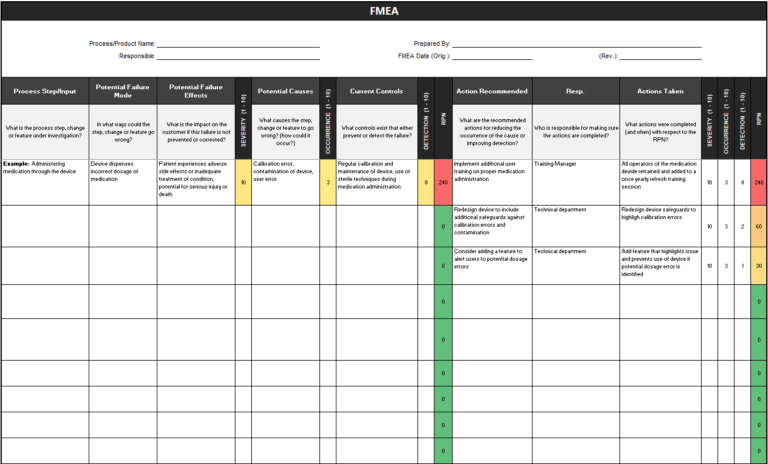
FMEA (Failure Mode and Effects Analysis) is a more detailed engineering tool that adds a third dimension: Detection (Probability x Severity x Detection). FMEA focuses on specific process or product failure points rather than general project risks.
Matrix (2D) FMEA (3D)

What are the 4 ways to treat a risk?

The standard responses are:
1. Avoid: Change plans to eliminate the risk entirely.
2. Mitigate: Reduce the likelihood or impact (e.g., safety guards).
3. Transfer: Shift responsibility (e.g., insurance).
4. Accept: Acknowledge the risk and monitor it without action.

What is "Residual Risk"?

Residual Risk is the level of risk remaining after you have implemented your mitigation plans or controls.

For example, wearing a seatbelt reduces the risk of injury in a car crash, but some risk still remains. The goal is to get the residual risk score down to an "Acceptable" (Green) level.
Free for Personal Use

Free

Instant Download • No CC Required

Download Excel
Secure SSL 256-bit Encrypted

What's Included

Free Template

Risk Assessment Template

Download Now

On this page